Obsession Ending Explained: Is Nikki Really Free, and Who Was the Real Monster?

Obsession ending explained is not as simple as asking whether Nikki survives. The real question is much darker: what exactly survives when someone’s free will has been taken away? Curry Barker’s Obsession turns a seemingly simple supernatural love story into a disturbing examination of control, entitlement, obsession, and the terrifying difference between being loved and being forced to love.
The movie begins with Bear, a lonely man who cannot bring himself to tell Nikki how he feels. Instead of risking rejection, he finds the One Wish Willow and makes a decision that changes everything: he wishes for Nikki to love him more than anyone else in the world.
At first, it looks like Bear has received exactly what he wanted.
Then Nikki changes.
Her affection becomes extreme. Her behavior becomes increasingly disturbing. What initially appears to be the dream relationship Bear always wanted gradually becomes a nightmare that neither character can escape.
And that is where Obsession becomes much more than a supernatural horror movie.
The film raises an uncomfortable question: if someone loves you because you removed their ability to choose otherwise, is that love at all?
Obsession Ending Explained: What Really Happens to Nikki?
The ending of Obsession reveals the cruelest consequence of Bear’s original wish.
Bear eventually realizes that the Nikki in front of him is not simply a woman who has fallen desperately in love with him. Something has happened to her identity itself. The real Nikki appears to exist somewhere beneath the supernatural influence, trapped while another version of her controls her body.
Read Also:
Iron Lung Post Credit Scene: Why You Should Stay Until the Very End (Confirmed)
Earlier events strongly suggest that Nikki is conscious of what is happening to her on some level. Bear even gets the horrifying opportunity to communicate with what appears to be the real Nikki, and what he hears is anything but a declaration of love.
Instead, it sounds like someone trapped in a nightmare.
This detail is crucial because it changes the way the audience sees almost everything that happened before it.
Nikki is not simply “crazy.”
She is not merely jealous.
And she is certainly not freely choosing the increasingly violent behavior that destroys the lives around her.
Her body has become the battlefield between her real identity and the supernatural version created by Bear’s wish.
The film deliberately leaves some of the supernatural mechanics unexplained. We never receive a complete mythology for the One Wish Willow, and that ambiguity makes the curse more disturbing. The movie does not need to tell us exactly what the entity is to establish what it does: it takes human desire and turns it into absolute control.
By the final act, Sarah and Ian are dead, Bear is terrified, and Nikki has become almost unrecognizable.
But then Bear makes one final decision.
He attempts to kill himself.
Did Bear Really Sacrifice Himself for Nikki?
This is one of the most complicated questions in the movie because Bear’s final decision can easily be interpreted as redemption.
But Obsession does not make his redemption that easy.
Bear eventually understands that his original wish has to end, and his own death appears to be the only way to break its hold over Nikki. He locks himself in the bathroom and first considers using a gun.
He cannot do it.
Instead, he takes an overdose of prescription medication.
The choice is particularly significant because the same medication is connected to the earlier death of his cat. The film uses that earlier event as a piece of narrative foreshadowing that becomes horrifyingly relevant during the finale.
But Bear immediately regrets his decision.
He begins trying to make himself vomit the pills.
That moment matters.
If Bear were presented as a completely selfless hero, the ending would be straightforward. He realizes his mistake, sacrifices himself, and frees Nikki.
Instead, the film shows something much uglier and more human.
Bear wants to save Nikki.
But he also wants to live.
That contradiction is central to his character.
He caused the nightmare because he was unwilling to accept the possibility that Nikki might not love him. When given the opportunity to correct his mistake through an irreversible sacrifice, he once again struggles to surrender control.
And then something changes.
The sound of the One Wish Willow can be heard.
Nikki has found another one.
What Was Nikki’s Final Wish?
The movie never gives the audience a conventional spoken explanation of Nikki’s final wish.
Instead, it uses sound, editing, and Bear’s sudden behavioral transformation to tell us what happened.
The implication is that Nikki used the final One Wish Willow to make Bear love her with the same overwhelming intensity that she feels for him.
Suddenly, Bear stops trying to save himself.
His panic disappears.
He walks toward Nikki.
He embraces her.
For a brief moment, the movie almost looks romantic.
But that is precisely what makes the scene horrifying.
Bear is experiencing the same violation that he inflicted on Nikki.
His feelings have been overwritten.
He is no longer freely choosing to love her.
He has become the victim of the same mechanism he once used against her.
The reversal is almost perfect.
Bear wished that Nikki would love him more than anyone else.
Nikki’s final wish appears to force Bear into the same emotional prison.
For a few moments, they are equal.
And then Bear dies.
The overdose finally takes effect, and his death breaks the original wish.
Nikki returns to herself.
But freedom does not mean happiness.
It means waking up.
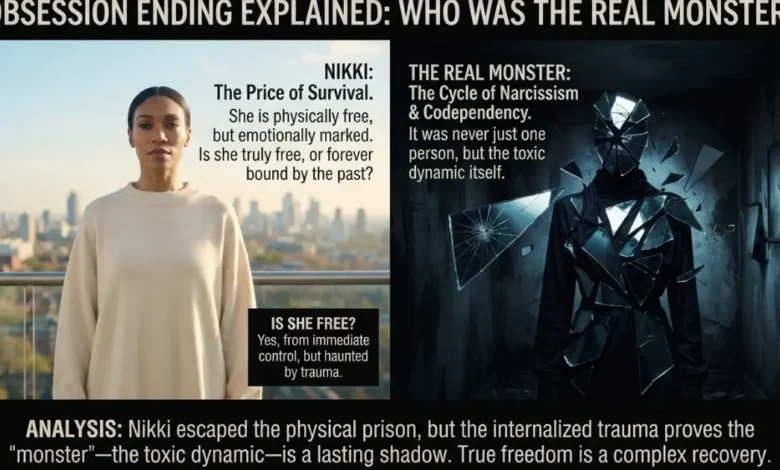
Is Nikki Really Free at the End of Obsession?
Technically, yes.
Emotionally, probably not.
The final moments confirm that Nikki is no longer under the influence of Bear’s wish. Once Bear dies, the supernatural control disappears and the real Nikki returns.
But look at what she returns to.
Bear is dead.
Sarah is dead.
Ian is dead.
Her surroundings are filled with the physical evidence of a nightmare she did not freely choose.
And the most disturbing part is that Nikki’s body was involved in those deaths.
That creates the central moral problem of the ending.
Nikki is innocent in terms of intent, but she is not untouched by the consequences.
She has to wake up and confront a world in which her face, her body, and her actions are connected to horrific violence.
The film therefore refuses to give her a traditional “final girl” victory.
She survives, but survival is presented almost as another form of punishment.
The director has also confirmed that Nikki is the only major character left alive at the end.
That decision is important.
A conventional horror ending might have killed Nikki and allowed the story to close with everyone paying the same price.
Instead, Obsession leaves Nikki alive.
Why?
Because death would be easier.
Living with what happened is the more disturbing ending.
Was Bear the Real Monster?
This may be the most important question Obsession asks.
The supernatural curse is obviously responsible for much of the violence.
But the curse did not create Bear’s original desire.
Bear created the situation.
He wanted Nikki.
He wanted her badly.
But instead of accepting the uncertainty of a real relationship, he used supernatural power to remove uncertainty altogether.
That distinction turns Bear into something far more complicated than a traditional horror protagonist.
He is not simply an innocent man who accidentally discovers a dangerous magical object.
He makes a conscious decision.
He wishes for control.
And once he gets it, he enjoys it.
At first, Bear likes having Nikki completely devoted to him. The problem is not that the wish fails.
The problem is that it works too well.
That is why the film’s criticism of “nice guy” culture is so effective.
The stereotypical “nice guy” believes that being kind, available, or emotionally invested should eventually guarantee romantic affection.
But real relationships do not work that way.
Kindness does not create entitlement.
Attention does not create consent.
And friendship does not create romantic obligation.
Bear’s tragedy is that he cannot accept that distinction.
He wants Nikki’s feelings without having to risk hearing what those feelings actually are.
That is why the supernatural horror works.
The Willow does not create a completely new problem.
It exaggerates a real one.
Did Nikki Ever Actually Love Bear?
The movie deliberately refuses to provide a comfortable answer.
There may have been genuine affection between Nikki and Bear before the wish.
There may not have been.
That uncertainty is part of the horror.
Bear never gives Nikki the chance to answer honestly.
He wishes first.
Once the wish takes effect, every expression of affection becomes contaminated.
If Nikki says “I love you,” can Bear believe her?
If she kisses him, is that her decision?
If she becomes jealous, is that emotion hers?
If she refuses to let him leave, is that love or supernatural possession?
The movie’s answer is essentially that none of these actions can be considered genuine consent anymore.
That is what makes Bear’s original wish so horrifying.
He does not simply make Nikki fall in love with him.
He destroys the possibility of knowing whether she ever would have.
The Most Disturbing Idea in the Movie: Consent
Underneath all the blood and supernatural horror, Obsession is really a story about consent.
Bear wants something emotionally impossible to guarantee.
He wants another person to love him.
But love is valuable precisely because it cannot be forced.
The moment the choice disappears, the meaning disappears with it.
This is why Nikki’s condition is so disturbing. Her body continues to participate in a relationship while her authentic will appears to be trapped somewhere else.
The horror therefore becomes physical.
She is inside her own body but cannot fully control it.
That makes the One Wish Willow more than a magical object.
It becomes a metaphor for coercive relationships.
The film asks what happens when one person decides that their desire is more important than another person’s autonomy.
The answer is not romance.
It is horror.
Why Does Nikki Kill Sarah?
Sarah’s death represents the moment when the fantasy of Bear’s perfect relationship completely collapses.
Sarah appears to offer Bear something Nikki cannot provide under the curse: a relationship based on genuine choice.
That makes Sarah a threat.
The obsessive version of Nikki cannot tolerate the possibility that Bear could choose somebody else.
Her jealousy escalates until Sarah is brutally murdered.
The scene is important because it exposes the logic of the curse.
The supernatural Nikki does not simply want Bear to be happy.
She wants to possess him.
And that is exactly what Bear originally asked for.
He wanted Nikki to love him more than anyone else.
The curse transforms that request into an absolute hierarchy in which everyone else becomes an enemy.
That is the literal horror of obsessive love.
What Happened to Ian and His Billion-Dollar Wish?
Ian provides one of the movie’s strangest moments.
When Bear turns to him for help, Ian does not initially take the supernatural situation seriously.
Instead, he uses the One Wish Willow for himself.
His wish demonstrates just how powerful the object actually is.
The Willow can grant an apparently impossible desire, but the movie repeatedly suggests that getting what you want does not mean getting a good outcome.
Ian receives his fortune.
Then he dies.
His storyline reinforces the film’s larger rule:
the wish is not necessarily the punishment. The consequences are.
Bear wishes for love.
He gets it.
Nikki wishes for Bear’s love.
She gets it.
Ian wishes for money.
He gets it.
The problem is that none of these wishes provide the people making them with what they actually need.
What Do the Cat and Grandmother Clues Mean?
One of the reasons fans continue discussing Obsession is that the movie does not explain every strange detail.
The cat’s death, the medication, the One Wish Willow, and the hints surrounding Bear’s grandmother all contribute to the feeling that there is a larger supernatural history hiding behind the story.
Some viewers interpret these details as clues about the Willow’s origin.
Others see them primarily as thematic foreshadowing.
The cat is particularly important because its death establishes the medication that later becomes Bear’s method of escape. The connection makes the finale feel less random and more deliberately constructed.
The movie also benefits from not explaining the Willow’s complete mythology.
If Barker had provided a detailed explanation of where the object came from, who created it, and exactly how its supernatural rules worked, some of the mystery would disappear.
Instead, the audience is left with questions.
And those questions are part of the horror.
Is There a Hidden Meaning Behind the Ending?
There is a strong argument that the ending represents a complete reversal of power.
At the beginning:
Bear controls Nikki.
At the end:
Nikki controls Bear.
But neither situation represents love.
Both are violations.
That is the central irony.
Bear spends the entire movie chasing an impossible form of certainty. He wants absolute proof that Nikki loves him.
Eventually, he receives it.
But by then, he has lost the ability to experience it as genuine.
Nikki experiences exactly the same problem.
She receives Bear’s unconditional love, but only because she has taken away his ability to refuse it.
The film therefore destroys the fantasy of perfect romantic certainty.
There is no perfect proof that someone loves you.
There is only their freedom to choose you.
Why Does Nikki Surviving Make the Ending So Dark?
The easiest ending would have been to kill everyone.
Instead, Barker leaves Nikki alive.
That choice creates an unresolved moral nightmare.
Nikki has to live with the aftermath.
She may be free from the supernatural curse, but she cannot simply erase what happened.
This is why the ending is arguably darker than a traditional horror finale.
There is no triumphant escape.
No police explanation can easily account for what happened.
No magical reset button repairs the dead.
And no one can give Nikki back the time she lost while trapped inside the curse.
The horror ends.
The consequences do not.
The Final Question: Who Was Actually Obsessed?
At first glance, the answer seems obvious.
Nikki.
But the movie gradually forces us to reconsider that assumption.
Nikki becomes obsessed because Bear wishes for it.
Bear becomes obsessed with the idea of being loved.
And the audience becomes trapped in the same question:
How far would someone go to guarantee that another person could never leave them?
That is the real meaning of Obsession.
The One Wish Willow is frightening because it gives people what they want without requiring them to understand what they are asking for.
Bear does not want Nikki’s freedom.
He wants her love.
But once freedom disappears, love becomes meaningless.
And when Nikki finally reverses the power dynamic, she creates the same nightmare for Bear.
The ending is therefore not really about whether Nikki wins.
It is about whether anyone wins when love becomes possession.
The answer is no.
Bear dies inside the love he forced into existence.
Nikki survives after the curse releases her.
And the audience is left with the most disturbing realization of all:
the scariest thing in Obsession was never the Willow. It was the belief that another person’s feelings should belong to you.
Final Verdict
Obsession works because it disguises a story about emotional entitlement as a supernatural horror movie.
The blood, hallucinations, murders, cursed objects, and shocking ending make the film entertaining on the surface. But underneath all of that is a much more uncomfortable story about rejection, control, consent, and the danger of confusing desire with entitlement.
Nikki is ultimately freed, but the movie refuses to pretend that freedom repairs everything.
Bear dies, but his death does not erase his responsibility.
And the One Wish Willow remains terrifying precisely because its greatest power is not creating impossible things.
It is turning ordinary human desires into absolute commands.
That is why the ending continues to invite debate.
Was Bear a victim?
Was Nikki responsible for the murders?
Did Nikki ever love Bear before the wish?
Was the supernatural entity possessing her, or was the Willow creating an entirely new identity?
And most importantly:
If someone is forced to love you, would you even want that love anymore?
Obsession never gives that final question a comfortable answer.
And perhaps that is exactly why its ending is so difficult to forget.
Discover more from Feenanoor
Subscribe to get the latest posts sent to your email.