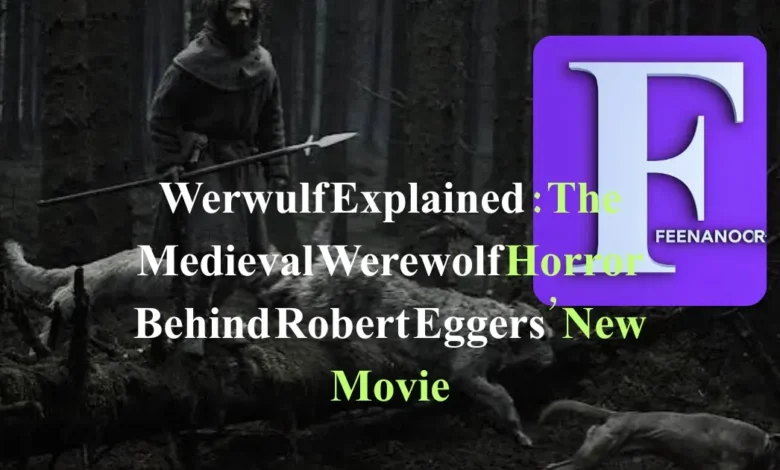
Robert Eggers is returning to the darker side of historical horror with Werwulf, a new werewolf movie that moves the creature away from the familiar settings and rules of modern horror and places it in medieval England. The film is officially scheduled to arrive in theaters on December 25, 2026, with Aaron Taylor-Johnson, Lily-Rose Depp, and Willem Dafoe leading the cast, while Eggers directs from a screenplay written with Sjón. Focus Features describes the movie as a story of devotion, damnation, and the devil within, while the available trailer footage presents a bleak countryside stalked by a mysterious creature and a transformation that suggests the horror is not simply coming from an animal attacking a village.
Feenanoor does not simply tell readers what Werwulf is. It explains the horror mythology and medieval ideas that make the movie different.
That is particularly important with Werwulf because the word “werewolf” already carries a large amount of modern horror baggage. Audiences have become accustomed to silver bullets, full moons, supernatural bites, rapid transformations, and creatures that follow a familiar set of rules established by decades of movies and television. Eggers’ film, however, is being presented through a very different historical framework. By placing its story in 13th-century England and grounding the horror in an environment where folklore, superstition, religion, violence, and fear were part of everyday life, Werwulf has the opportunity to explore an older conception of the werewolf rather than simply reproducing the modern cinematic version of the monster. Variety’s reporting on the trailer identifies the film specifically as a 13th-century werewolf tale in which a mysterious creature stalks the countryside while local folklore becomes terrifyingly real for the villagers.
Werwulf Explained: Why the Medieval Setting Matters
The most important detail to understand about Werwulf is not necessarily the identity of the creature, but the world in which that creature exists. A werewolf appearing in a contemporary city belongs to a very different horror tradition from a werewolf appearing in medieval England. Modern characters have access to cameras, forensic investigation, emergency services, scientific explanations, and a vast network of information that can quickly challenge supernatural beliefs. A medieval village had none of those mechanisms. A strange death in the countryside could become a matter of folklore, religion, fear, or superstition before anyone could establish what had actually happened, and a predator resembling something beyond the natural world could become a terrifying explanation for events that people were already struggling to understand.
Read Also:
Iron Lung Post Credit Scene: Why You Should Stay Until the Very End (Confirmed)
This makes the historical setting more than visual decoration. The medieval countryside becomes part of the horror itself because the people living there do not approach the unknown with the same assumptions as a modern audience. The fear of wolves was already grounded in reality, particularly in rural communities where livestock and human settlements existed close to wilderness. A werewolf therefore takes an existing threat and makes it profoundly more disturbing: the dangerous animal is no longer simply outside the community, because the predator may actually be a human being from within it. That transformation creates a particularly powerful form of horror because the boundary between familiar and monstrous becomes almost impossible to maintain.
The Werewolf Before Hollywood Invented Its Rules
One of the easiest mistakes to make when discussing Werwulf is to assume that the werewolf has always followed the same mythology audiences know from modern horror. Historical werewolf traditions were considerably more complicated than that. Stories of human beings becoming wolves appeared in European folklore and medieval literature in different forms, and the transformed figure could be portrayed as a monster, a cursed person, an enchanted individual, a dangerous outcast, or even a sympathetic character whose transformation was part of a larger tragedy.
That matters because modern werewolf mythology often feels much more standardized than the older traditions actually were. The full moon, silver bullet, infectious bite, and automatic loss of human identity are recognizable conventions, but they should not be treated as universal rules that existed unchanged throughout medieval Europe. Earlier stories could approach transformation through different supernatural explanations and could be far more interested in the relationship between the human being and the animal form than in the mechanics of killing the monster.
This gives Robert Eggers an unusually rich foundation for Werwulf. Instead of asking the audience to accept another predetermined set of werewolf rules, the film can create its own interpretation from the older cultural imagination surrounding the creature. That is particularly appropriate for Eggers, whose period films have repeatedly attempted to make historical worlds feel like complete cultures rather than costumes placed around a modern story.
The Darker Meaning of Becoming a Werewolf
The most disturbing interpretation of a werewolf is not necessarily that a person becomes a monster. It is that the person may still exist somewhere inside the monster. That possibility transforms the story from a simple creature feature into something closer to psychological and existential horror. If the human consciousness survives the transformation, then the creature’s violence is also a form of imprisonment, and every transformation becomes a conflict between identity and instinct.
Medieval werewolf stories provide examples of precisely this kind of complexity. One of the best-known is Bisclavret, the 12th-century lai by Marie de France, in which a nobleman secretly becomes a werewolf and his wife eventually betrays him by preventing his return to human form. The important point is that Bisclavret is not presented as an uncomplicated embodiment of evil; his transformation and subsequent treatment are tied to questions of loyalty, betrayal, identity, and justice. Another medieval tradition appears in Guillaume de Palerne, where the werewolf is also connected to enchantment and is not simply portrayed as an evil creature. These stories demonstrate that the medieval werewolf could function as a human tragedy as much as a supernatural threat.
That distinction provides an important lens through which to approach Werwulf. If the creature is connected to a human character and to a family or community that knows the person behind the monster, then the central fear is not merely that something is hunting people in the woods. The deeper fear becomes the possibility that someone you love can become the thing everyone else has learned to fear.
Why Robert Eggers Fits the Werwulf Myth
Robert Eggers has spent much of his career turning historical environments into active components of horror. The Witch used religious anxiety and isolation to create a supernatural nightmare, The Lighthouse transformed isolation and folklore into psychological terror, The Northman reconstructed a Viking world through mythology and historical detail, and Nosferatu returned to gothic vampire horror through an intensely atmospheric period setting. His films repeatedly demonstrate an interest in the beliefs of people living inside worlds that modern audiences can observe from the outside.
That approach is especially relevant to Werwulf. Focus Features identifies the film as Eggers’ fourth collaboration with the studio and describes it as a visceral and haunting horror story centered on devotion, damnation, and the “devil within.” The phrase “devil within” is particularly useful when considering the film’s potential thematic direction because it suggests that the horror is not necessarily limited to an external creature. The danger may be connected to the human being who carries the curse, the fear experienced by those around him, or the struggle between the person’s identity and the thing that emerges from it.
Eggers has also demonstrated that historical accuracy can be used as a storytelling tool rather than simply as a production detail. In discussing The Northman, Focus Features described how the filmmaker and his collaborators researched the period in detail while attempting to recreate not only the physical world but also the belief system of the people living inside it. That approach is significant when considering Werwulf, because folklore only becomes frightening when the characters themselves have reason to believe that the supernatural world is real.
Werwulf and the Fear of the Unknown
The trailer provides another important clue about how the film may approach its monster. Rather than immediately presenting the creature as a conventional movie werewolf, the footage reported from CinemaCon emphasized bodies, disturbed graves, frightened villagers, darkness, and a transformation involving Taylor-Johnson. Variety reported that the full monstrous appearance was not completely revealed, which allows the film to maintain uncertainty around the creature rather than turning it immediately into a recognizable visual icon.
That decision matters because horror often becomes weaker when the audience understands everything too quickly. A creature becomes less mysterious once its appearance, behavior, weaknesses, and rules are completely established. By keeping parts of the werewolf hidden, Werwulf can make the audience experience the same uncertainty as the people inside the story. They do not know exactly what is stalking the countryside, what it wants, or whether the human being associated with the creature can be separated from it.
This approach also fits the broader style associated with Eggers. His horror rarely depends entirely on sudden shocks. Atmosphere, anticipation, historical belief, isolation, and the feeling that something terrible is approaching often do as much work as the monster itself. With Werwulf, the medieval landscape can therefore function almost like another character, surrounding the villagers with darkness while making the creature feel like something that belongs to an older world.
Is Werwulf Based on a Real Medieval Werewolf Story?
At this stage, it would be misleading to describe Werwulf as a direct adaptation of a specific medieval werewolf legend unless the filmmakers establish such a source. What can be said with confidence is that the film uses a medieval English setting and places its werewolf story within a much older European tradition of human-animal transformation. Medieval literature contains multiple examples of werewolf narratives, which means Eggers does not need to reproduce one particular legend for the film to have a meaningful relationship with medieval folklore.
The distinction is important because Werwulf appears to be drawing from the idea of medieval werewolf horror rather than simply adapting a single famous story. That gives Eggers considerably more creative space. He can take themes that existed across different traditions—transformation, curses, identity, isolation, fear of the wilderness, the relationship between humans and animals, and the possibility of supernatural punishment—and reshape them into a cinematic horror story designed for a modern audience.
This is also why the film’s historical setting deserves more attention than a conventional release-date article might give it. The question is not simply whether the movie has a werewolf. The question is what a werewolf means when it exists inside a medieval society that already has its own understanding of monsters, curses, sin, nature, and supernatural forces.
The Full Moon Is Not the Whole Werewolf Story
The full moon has become almost inseparable from the modern image of the werewolf, but that association should not be mistaken for a universal historical rule. Different folklore traditions have offered different explanations for transformation, and the werewolf has never possessed one consistent mythology shared across every European culture and historical period.
That is another reason Werwulf is interesting before its release. The title, setting, and historical framework create the possibility of a werewolf story that does not have to obey every convention audiences have seen in contemporary horror. The movie can establish its own mythology while drawing inspiration from older traditions, which may make its version of the creature feel unfamiliar even though the basic concept is centuries old.
The distinction between modern werewolf mythology and medieval werewolf folklore is therefore central to understanding the film. If the audience approaches Werwulf expecting another variation of the standard Hollywood werewolf, some of the film’s choices may seem strange. If it is approached as a historical horror story investigating an older conception of transformation, those same choices can become part of what makes the movie distinctive.
What Makes Werwulf Different From a Typical Werewolf Movie?
The answer lies in the combination of its historical setting, its folklore-driven premise, and Robert Eggers’ approach to period horror. A conventional werewolf movie can use the creature as a threat that enters an otherwise recognizable modern world. Werwulf appears to be doing something more deeply connected to its environment: it places the monster inside a society where folklore and supernatural belief can influence how people interpret violence, disease, death, and unexplained events.
The difference is subtle but important. The werewolf does not need to be an alien element invading the story. It can become an extension of the world itself. Wolves already exist. Fear already exists. Religious and supernatural beliefs already exist. The wilderness already represents danger. The monster simply brings all of those fears together in one human-shaped creature.
That is where Werwulf can potentially become more than another entry in the werewolf genre. The movie has the opportunity to explore the uncomfortable idea that civilization and monstrosity are not necessarily opposites. A village can be terrified of a creature while simultaneously creating the conditions that make the creature’s existence meaningful. The monster may be supernatural, but the fear surrounding it is deeply human.
The Horror Behind the Word “Werwulf”
Even the title deserves attention because Werwulf immediately sounds older and less familiar than the standard word “werewolf.” The historical term werwolf is associated with the concept of a human being transformed into a wolf, and the title consequently reinforces the film’s connection to an older linguistic and cultural tradition rather than presenting the creature as a purely modern invention.
For a filmmaker like Eggers, that distinction feels appropriate. His work often attempts to make audiences feel as though they have entered a world governed by beliefs that existed long before modern explanations replaced them. The title therefore functions almost like an invitation to approach the film from the perspective of its historical setting rather than through the expectations created by contemporary werewolf movies.
That is also where the title becomes especially useful for Feenanoor’s approach. A reader searching for Werwulf Explained is not necessarily looking only for a plot summary. They may want to understand why the movie is called Werwulf, why it is set in medieval England, what kind of werewolf tradition it draws upon, and why Robert Eggers would choose this particular version of the monster. Those questions provide much more useful material for an explanatory horror article than simply listing the cast and release date.
What We Can Expect From Werwulf
The finished movie will ultimately determine how deeply Werwulf explores medieval folklore, but the information currently available establishes a clear framework. Focus Features has confirmed the film as a horror release for December 25, 2026, with Robert Eggers directing and writing alongside Sjón, while Aaron Taylor-Johnson, Willem Dafoe, and Lily-Rose Depp lead the cast. The studio has also released the official trailer, making Werwulf one of the major upcoming horror releases already positioned for a theatrical audience.
What remains unknown is arguably the most interesting part. We do not yet have the complete mythology of the creature, the full explanation for the transformation, or the ultimate meaning of the werewolf within the story. Those answers belong to the finished movie. Until then, the most useful way to understand Werwulf is to look backward rather than forward—to the medieval traditions that existed before Hollywood turned the werewolf into a standardized monster.
Why Werwulf Could Be a Different Kind of Horror Movie
The real question surrounding Werwulf is therefore not whether Robert Eggers has made another scary werewolf movie. The more interesting question is whether he can make audiences see the werewolf differently by returning the creature to a world that existed before modern horror gave it a fixed set of rules. The combination of 13th-century England, folklore, supernatural belief, rural isolation, and Eggers’ established interest in historical horror gives the film a foundation that separates it from the typical contemporary werewolf story.
A werewolf can be frightening because it is powerful, fast, violent, and almost impossible to recognize until it is too late. But the older mythology offers a more disturbing possibility: the monster may still contain the person who once lived inside it. That creates a different kind of fear, one built around identity, family, betrayal, shame, and the possibility that becoming a monster does not necessarily mean losing everything human.
That is ultimately what makes Werwulf worth watching as a piece of horror mythology rather than simply another monster movie. Robert Eggers has taken a creature audiences already think they understand and placed it inside a historical world where the meaning of transformation can be much darker and less predictable. Werwulf Explained is therefore not simply about explaining what the creature is. It is about understanding the older horror idea behind the creature—and why a medieval werewolf may be far more unsettling than the Hollywood version audiences already know.
When Werwulf finally reaches theaters on December 25, 2026, the questions will become much more specific: what exactly happened to the characters, what rules govern the creature, what does the transformation mean, and how does the story end? Those questions will belong to future Feenanoor explainers. For now, the most important mystery is the one that comes before the ending: what kind of werewolf has Robert Eggers brought back from the medieval imagination?
Discover more from Feenanoor
Subscribe to get the latest posts sent to your email.