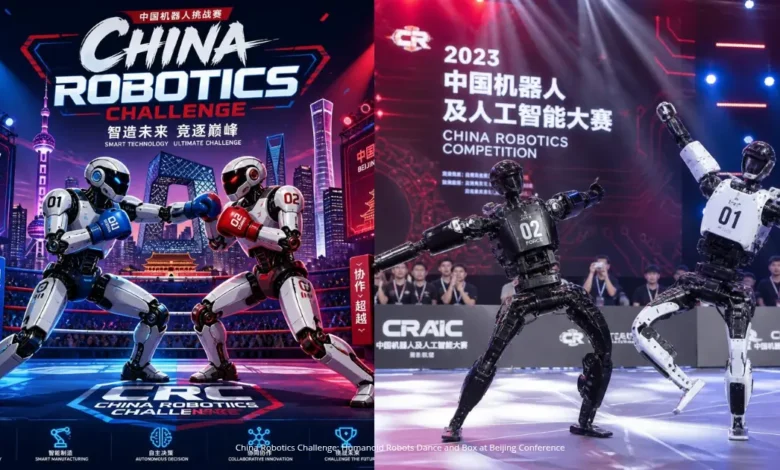
China Robotics Challenge is taking on a new meaning as China’s humanoid robots move beyond basic walking demonstrations and show off increasingly athletic abilities, including dancing, boxing, kickboxing, table tennis, and other coordinated movements. At the 2026 World Robot Conference in Beijing, humanoid machines attracted large crowds with demonstrations designed to showcase how quickly robotics hardware and artificial intelligence are advancing. The five-day conference, which began on August 19, features around 3,000 robotic products and more than 300 exhibitors, with Chinese companies using the event to demonstrate everything from industrial automation systems to humanoid robots designed for service, entertainment, logistics, and future household applications.
The most eye-catching demonstrations came from humanoid robots that looked less like conventional industrial machines and more like athletic performers. Some robots demonstrated synchronized dance routines, while others performed boxing and kickboxing movements that included rapid punches and high kicks. Reuters footage from the conference showed Unitree humanoid robots performing a coordinated group dance, while other machines demonstrated combat-style movements at exhibitor booths. These performances are not simply designed to entertain visitors. They are also a highly visible way for robotics companies to demonstrate improvements in balance, motion planning, motor control, coordination, and real-time response.
Read Also:
Alibaba Bans Claude Code Over Security Concerns as AI Rivalry With Anthropic Intensifies
China Robotics Challenge Highlights a New Era of Humanoid Machines
China Robotics Challenge highlights a much larger race taking place inside the country’s robotics industry. Chinese manufacturers are increasingly trying to build machines that can operate in environments designed for humans, using two legs, two arms, cameras, sensors, artificial intelligence, and sophisticated control systems to navigate the physical world. The challenge is considerably harder than making a robot move from one location to another because humanoid machines must constantly maintain their balance while coordinating dozens of joints and responding to changes in their surroundings.
Dancing is a particularly useful demonstration because it requires synchronized movement across the entire body. A humanoid robot cannot simply move its arms while keeping the rest of its body stationary. When the robot shifts its weight, rotates its torso, bends its knees, or raises one leg, its control system has to compensate for changes in its center of mass. The robot must calculate movements quickly enough to prevent itself from falling while also following the choreography. Unitree’s group dance demonstration at the Beijing conference showed how far these systems have progressed in coordinated whole-body movement.
Boxing and kickboxing present an even more difficult engineering problem because the movements are faster and more dynamic. When a humanoid robot throws a punch or launches a kick, its body experiences changes in momentum that can destabilize the machine. A successful demonstration therefore requires sophisticated motion control, precise actuator coordination, and rapid balance correction. Researchers are also exploring AI-based approaches to autonomous humanoid boxing, including systems that separate high-level decision-making from low-level physical control to reduce catastrophic balance failures.
Chinese Robots Are Moving Beyond Dance and Boxing
While dancing and fighting have generated the most attention, the 2026 World Robot Conference is much broader than a showcase of robotic athleticism. Chinese companies are demonstrating machines intended for factories, logistics operations, healthcare, education, retail, entertainment, and other practical environments. According to Reuters, more than 300 Chinese exhibitors are participating, with companies including Unitree, UBTECH, Leju Robotics, Galbot, Fourier Intelligence, LIMX Dynamics, Robotera, and SIASUN presenting different robotic platforms.
UBTECH, for example, is presenting its Walker C1 service-focused humanoid robot, while Leju Robotics is showcasing KUAVO for industrial applications. Galbot is displaying a warehouse-assistant robot, while Fourier Intelligence is presenting its GR-3 humanoid platform with applications that include eldercare and education. LIMX Dynamics is showing Luna, a humanoid robot designed around learning capabilities, while Robotera is targeting logistics and manufacturing with its L7 platform. The variety of these machines demonstrates that China’s robotics industry is not pursuing a single use case. Companies are competing to determine where humanoid robots can generate the most practical value.
The conference also includes demonstrations that bring robotics closer to everyday activities. Robots have been shown attempting tasks such as folding clothes, playing table tennis, playing soccer, and interacting with people. Some demonstrations have worked impressively, while others have exposed the limitations of current systems. One robot attempting to fold a shirt reportedly struggled with the task, highlighting a fundamental problem in robotics: an action that appears simple to a human can require extremely sophisticated perception and manipulation capabilities for a machine.
Unitree Robots Become a Major Attraction in Beijing
Unitree Robotics has emerged as one of the most recognizable Chinese robotics companies, particularly because its machines have repeatedly gone viral for performing acrobatics, martial-arts movements, running demonstrations, and synchronized performances. The company was once best known for its robotic dogs, but humanoid robots have increasingly become central to its business and public image.
At the Beijing conference, Unitree’s humanoid robots once again became a major attraction. The company’s machines demonstrated synchronized dancing and other physical activities, reinforcing the impression that humanoid robots are becoming significantly more agile. Unitree’s rise has also coincided with intense investor interest in the sector. The company recently made its debut on China’s Shanghai stock market, where its shares experienced a dramatic surge, reflecting the extraordinary expectations surrounding humanoid robotics and artificial intelligence.
Unitree’s CEO Wang Xingxing has also suggested that robotics could eventually experience a breakthrough comparable to the emergence of ChatGPT in generative AI. He described a possible future in which robots could understand simple voice or text instructions and perform unfamiliar tasks in real-world environments. However, he has also indicated that reaching this level of software capability could still take years, emphasizing that impressive hardware demonstrations do not automatically mean that robots are ready for widespread autonomous use.
The Real Test Is Whether Humanoid Robots Can Do Useful Work
The biggest issue facing China’s robotics industry is no longer whether humanoid robots can dance or box. The industry has already demonstrated that these machines can perform increasingly sophisticated physical movements. The much harder question is whether they can perform useful work consistently, safely, and economically.
That distinction matters because a choreographed demonstration takes place in a controlled environment. The robot may know exactly what movement is coming next, where it needs to stand, and how it needs to respond. A factory, warehouse, hotel, hospital, or home is completely different. People move unpredictably, objects are placed in different locations, lighting conditions change, surfaces can be uneven, and tasks rarely happen exactly the same way twice.
For a humanoid robot to become commercially valuable, it needs to understand these variations and adapt to them without constant human intervention. It must be able to identify objects, understand instructions, plan a sequence of actions, manipulate objects accurately, recognize when something has gone wrong, and recover without damaging itself or the surrounding environment.
This is where embodied AI becomes increasingly important. Traditional AI systems can process text, images, audio, and other digital information, but humanoid robots need AI that can connect perception with physical action. The machine must understand what it sees and then determine how its body should respond. That creates an enormous technical challenge because the physical world is far less predictable than a digital environment.
China Is Trying to Turn Humanoid Robots Into a Commercial Industry
China’s robotics push is increasingly focused on moving from spectacular demonstrations to actual commercial deployment. Reuters reported that humanoid robots are already beginning to appear in areas such as hotel deliveries and selected manufacturing operations, although widespread adoption remains limited. The industry is now facing a commercial test in which companies must prove that their robots can deliver measurable productivity rather than simply generate impressive videos.
Cost remains one of the biggest barriers. Some humanoid robots in China currently cost roughly 300,000 to 500,000 yuan, making them expensive compared with many conventional automation systems. Companies therefore need to show that humanoid machines can generate enough economic value to justify their purchase, maintenance, training, integration, and operating costs. If a robot is expensive but performs tasks less efficiently than a human worker or conventional industrial robot, businesses have little reason to deploy it on a large scale.
This explains why the industry’s next phase could look very different from the current wave of viral demonstrations. The winning robots may not necessarily be the fastest, strongest, or most entertaining machines. Instead, the companies that succeed could be those that develop robots capable of reliably completing repetitive tasks at a competitive cost.
Artificial Intelligence Could Be the Key to the Next Breakthrough
The hardware used in modern humanoid robots has advanced rapidly, but artificial intelligence may ultimately determine how useful these machines become. A robot needs more than powerful motors to operate independently. It needs a software system capable of interpreting visual information, understanding instructions, predicting the consequences of its movements, and selecting appropriate actions.
Researchers are increasingly working on world models and embodied AI systems that allow robots to learn from large quantities of physical interaction data. Instead of programming every movement individually, developers want robots to learn general patterns that can be applied to new situations.
This approach could eventually allow a person to tell a humanoid robot to perform a task such as “clean the kitchen” or “organize these boxes” without manually programming every step. The robot would need to identify the objects around it, determine what the instruction means, plan a sequence of actions, and adjust its behavior when something unexpected happens.
Unitree’s Wang has described this potential development as a possible “ChatGPT moment” for robotics. But the comparison should be treated as a long-term vision rather than a statement that current humanoid robots already possess this capability. Today’s machines can perform remarkable demonstrations, but they still struggle with many tasks that humans consider routine.
Why Humanoid Design Matters
The reason companies are investing so heavily in humanoid robots is partly connected to the environment in which humans already live and work. Buildings, tools, vehicles, shelves, doors, stairs, workstations, and many other objects have been designed around the human body.
A robot with a human-like form could potentially use existing infrastructure without requiring companies to redesign entire workplaces. A humanoid could theoretically climb stairs, carry objects, use human tools, reach shelves, operate equipment, and move through spaces designed for people.
That does not mean humanoid robots will automatically be the best solution for every task. Specialized machines can often outperform humanoids in controlled environments. Industrial robotic arms, autonomous mobile robots, and other purpose-built systems may remain more efficient for specific applications. The advantage of a humanoid robot is flexibility: one machine could potentially perform many different tasks in environments that were never specifically designed for robots.
That flexibility is one of the reasons China’s robotics companies are investing heavily in humanoid platforms.
Beijing Is Becoming a Major Stage for the Global Robotics Race
The World Robot Conference in Beijing provides a snapshot of the scale of China’s robotics ambitions. The 2026 event features thousands of robotic products and hundreds of exhibitors, with humanoid machines receiving substantial public attention. The conference is also taking place during a period of intense investment and competition in the global robotics industry.
China’s position in humanoid robotics has become particularly significant because the country combines robotics research with a massive manufacturing ecosystem. Chinese companies already have deep supply chains for electronics, batteries, motors, sensors, mechanical components, and industrial equipment. If humanoid robots eventually reach mass-market production, those manufacturing capabilities could help Chinese manufacturers scale faster and reduce costs.
At the same time, the industry faces geopolitical challenges. Chinese robotics companies are increasingly encountering restrictions and scrutiny in overseas markets, particularly in the United States, where concerns about national security and technology transfer have affected access to some foreign-made robotic systems. These restrictions could make international expansion more difficult for Chinese manufacturers even as domestic competition continues to intensify.
China Robotics Challenge Could Define the Next Stage of AI
China Robotics Challenge is ultimately about much more than robots dancing on a stage. The demonstrations in Beijing show how artificial intelligence is moving from software into the physical world. Humanoid robots are becoming more capable of running, jumping, dancing, boxing, playing sports, and interacting with objects, but their real value will be determined by what they can accomplish outside carefully controlled demonstrations.
The next major milestone will be reliability. A commercially successful humanoid robot must be able to work for long periods without constant supervision, understand changing environments, complete tasks accurately, recover from mistakes, and operate safely around people. It also needs to become affordable enough for businesses to justify purchasing large numbers of machines.
China’s robotics industry appears determined to solve those problems. The scale of investment, the number of competing companies, and the rapid pace of hardware development suggest that humanoid robotics is entering a much more serious phase. The spectacle of dancing and boxing may attract the cameras, but the real competition is happening in factories, laboratories, training centers, and AI development teams.
For now, the robots performing at the Beijing conference represent both progress and a warning. They show that humanoid machines can already achieve physical movements that would have seemed futuristic only a few years ago. But they also demonstrate how far the industry still has to go before robots become dependable general-purpose workers.
The China Robotics Challenge is therefore entering its most important stage. The question is no longer whether Chinese robots can impress an audience. They clearly can. The question is whether those machines can transform that impressive physical capability into reliable, affordable, and commercially useful work. If Chinese robotics companies can close that gap, the humanoid robot demonstrations taking place in Beijing this week could eventually be remembered as an early chapter in a much larger transformation of artificial intelligence and automation.
FAQ About the China Robotics Challenge
What is the China Robotics Challenge?
The China Robotics Challenge refers in this article to the rapidly developing competition among Chinese robotics companies to create increasingly capable humanoid robots. The 2026 World Robot Conference in Beijing provides a major showcase for these technologies, including robots capable of dancing, boxing, playing sports, and performing practical tasks.
Why are Chinese humanoid robots performing boxing demonstrations?
Boxing and kickboxing are useful demonstrations because they test dynamic balance, coordination, motion planning, actuator control, and the robot’s ability to move quickly without falling. These movements are considerably more demanding than simply walking in a straight line.
Which company is attracting attention at the Beijing robotics conference?
Unitree Robotics is one of the most visible companies at the event. Its humanoid robots have gained international attention for athletic demonstrations, including dancing, martial-arts movements, and other highly dynamic actions. The company is also attracting major investor attention following its Shanghai stock-market debut.
Are humanoid robots ready to replace human workers?
Not yet on a broad scale. Current humanoid robots can perform impressive demonstrations and are beginning to enter selected commercial environments, but they still face significant challenges involving reliability, autonomy, dexterity, cost, battery life, safety, and real-world productivity.
What comes next for China’s humanoid robots?
The next major step is moving from demonstrations to practical deployment. Companies need to prove that humanoid robots can perform useful tasks repeatedly and economically in factories, warehouses, hotels, healthcare environments, retail operations, and eventually homes. Artificial intelligence and embodied AI will play a central role in making that transition possible.
Discover more from Feenanoor
Subscribe to get the latest posts sent to your email.