28 Years Later: The Bone Temple takes the world of the Rage Virus in a much darker direction.
Instead of treating the infected as the only threat left after civilization collapses, the movie asks a more disturbing question: What happens when people who survive the apocalypse start creating their own rules, religions, and forms of power?
Directed by Nia DaCosta and written by Alex Garland, The Bone Temple continues directly from the events of 28 Years Later and expands the franchise beyond traditional infected horror. Sony’s official synopsis describes a world in which the infected are no longer necessarily the greatest threat, because the survivors themselves can become stranger and more terrifying.
That idea is at the heart of the movie.
The film introduces viewers to Jimmy Crystal, a brutal cult leader whose followers are known as the Jimmies, while Dr. Ian Kelson continues his dangerous work studying the long-term effects of the Rage Virus. Meanwhile, Spike finds himself trapped between these two worlds as he tries to survive.
The result is one of the franchise’s strangest and most disturbing chapters—and a movie that currently holds a 91% Tomatometer score on Rotten Tomatoes.
Read Also:
Iron Lung Post Credit Scene: Why You Should Stay Until the Very End (Confirmed)
Werwulf Explained: The Medieval Werewolf Horror Behind Robert Eggers’ New Movie
Why 28 Years Later: The Bone Temple Is So Different
The original 28 Days Later was built around the immediate terror of an outbreak.
The world had collapsed almost overnight, London had become a ghost town, and the infected represented a seemingly unstoppable force.
More than two decades later, the franchise has moved into a different phase.
The Rage Virus is no longer a brand-new disaster. Entire generations have grown up in its aftermath. Society has had time to adapt, rebuild, create new traditions, and develop new systems of belief.
That creates a very different kind of horror.
In The Bone Temple, the question isn’t simply whether humanity can survive the infected.
It’s whether humanity can remain human after living with the consequences of the outbreak for so long.
The film pushes that idea through Jimmy Crystal and his followers, creating a group that is visually bizarre, culturally specific, and genuinely disturbing.
Who Is Jimmy Crystal?
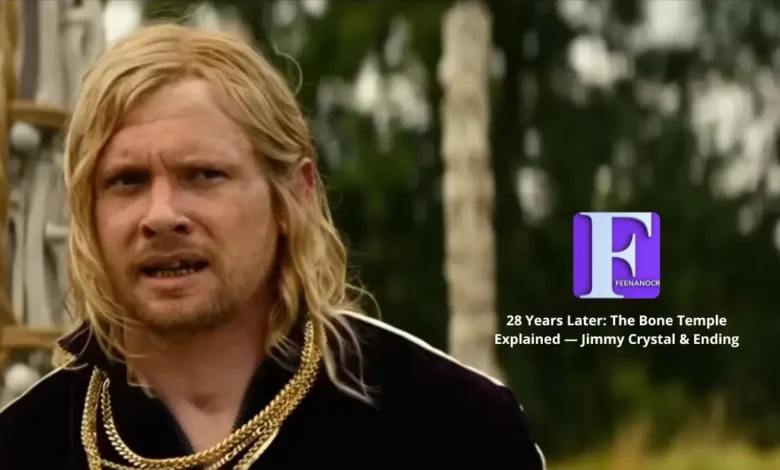
Jimmy Crystal, played by Jack O’Connell, is the main human antagonist of The Bone Temple.
He is not simply another survivor trying to stay alive.
Crystal has built an ideology around himself and turned his followers into a violent cult known as the Jimmies, or the Fingers.
Sony’s official FAQ describes the Jimmies as a deadly survivor faction led by Crystal. His followers act as extensions of his will, carrying out his commands in a world where traditional institutions have disappeared.
Crystal calls himself Sir Lord Jimmy Crystal, and his authority comes from a mixture of charisma, violence, religious imagery, and fear.
He has effectively created his own mythology.
And that mythology is one of the most disturbing parts of the movie.
Why Do Jimmy Crystal and His Followers Look Like Jimmy Savile?
One of the strangest elements of The Bone Temple is the appearance of the Jimmies.
They wear brightly colored tracksuits, peroxide-blond wigs, and deliberately exaggerated versions of a look associated with British television personality Jimmy Savile.
For American audiences, the reference may initially seem bizarre or even random.
For British audiences, it is much darker.
Savile was a hugely recognizable British celebrity whose public image included television fame, charity work, eccentric clothing, and a distinctive hairstyle. After his death, however, extensive allegations and investigations exposed decades of sexual abuse.
The film deliberately uses the disconnect between Savile’s public image and his hidden crimes as part of its horror.
In the post-apocalyptic world of 28 Years Later, historical memory has been damaged.
The people who grew up after the collapse do not necessarily understand the world that existed before the Rage Virus.
As a result, someone like Jimmy Crystal can look at fragments of old media and reconstruct the past in a completely distorted way.
The Guardian noted that the Savile-inspired imagery became particularly controversial after some American moviegoers began dressing like the Jimmies without realizing the real-world meaning behind the character’s appearance.
That reaction actually reinforces the movie’s underlying idea: history can become dangerous when people remember the image but forget the truth behind it.
Why Does Everyone Call Themselves Jimmy?
The Jimmies take their obsession even further.
Members of the group abandon their individual identities and adopt versions of the name Jimmy.
This is more than a strange fashion choice.
It demonstrates how completely Crystal’s personality has taken over the group.
Individual identity disappears, and everyone becomes part of the same mythology.
The group is no longer made up of ordinary survivors.
It has become a hierarchy built around one man’s interpretation of the world.
That makes Crystal particularly dangerous because his power doesn’t depend solely on physical strength.
He has convinced other people to believe in him.
And in a world without governments, police, courts, or stable institutions, belief can become a weapon.
The Jimmies Are More Than a Gang
Calling the Jimmies a gang doesn’t fully describe what they are.
They operate more like a violent cult.
They have their own rules, rituals, hierarchy, symbols, and ideology.
They attack other survivor communities and use brutality to maintain control.
The contrast between their colorful appearance and their extreme violence is intentional.
On the surface, they look almost ridiculous.
Underneath that appearance is a group capable of torture, murder, and ritualized violence.
That contradiction makes them even more disturbing.
The franchise has always explored what people become when civilization disappears. The Bone Temple simply takes that question further.
The infected destroy bodies.
The Jimmies destroy identities.
What Happens to Spike?
Spike, played by Alfie Williams, remains at the center of the story.
After everything he experienced in 28 Years Later, he finds himself caught in an increasingly dangerous world.
His encounter with Jimmy Crystal becomes a nightmare because Crystal does not simply want to kill him.
He wants to control him.
Spike therefore becomes trapped between two different forms of survival.
On one side are the infected and the physical threat created by the Rage Virus.
On the other is a human society that has transformed survival into a system of violence, obedience, and fanaticism.
This is one of the reasons Spike’s story is so important to the movie.
He represents a younger generation that has grown up after the collapse and must decide what kind of world it wants to inherit.
What Is Dr. Ian Kelson Doing?
While Spike is dealing with Crystal and the Jimmies, Dr. Ian Kelson, played by Ralph Fiennes, is investigating another side of the Rage Virus.
Kelson has been studying the infected and trying to understand what has happened to them over the decades.
One of the most important developments involves the Alpha infected, including Samson.
These creatures demonstrate that the virus has not simply remained unchanged.
The world has changed.
The infected have changed.
And scientists like Kelson are beginning to understand that the long-term consequences of the Rage Virus may be far more complicated than anyone originally imagined.
Sony’s official material specifically presents Kelson’s discovery as something that could potentially change the world.
What Is the Bone Temple?
The Bone Temple becomes the point where the movie’s major storylines finally collide.
Kelson’s scientific work and Jimmy Crystal’s religious mythology converge in a place that feels almost designed to blur the line between science, religion, madness, and horror.
Crystal believes in a supernatural explanation for the world around him.
Kelson understands the world through science.
But both men are trying to understand forces that have fundamentally changed humanity.
That collision creates the movie’s most intense sequence.
And it leads directly to Jimmy Crystal’s downfall.
Does Jimmy Crystal Die?
Yes. Jimmy Crystal is ultimately killed.
The final confrontation takes place after the Jimmies arrive at the Bone Temple.
Kelson initially plays along with Crystal’s beliefs and allows the cult leader to interpret the events around him through his religious worldview.
But the situation eventually collapses.
Crystal discovers that Kelson is not the supernatural figure he believes him to be.
The revelation destroys the mythology that has supported his power.
Crystal attacks Kelson, but the Jimmies begin turning against their leader.
Spike eventually stabs Crystal, while Jimmy Ink—whose real identity is Kelly—helps bring the violent group down.
Crystal is ultimately left hanging upside down on a crucifix as his world collapses around him.
His death is important because it shows that his greatest weakness was not physical.
It was the belief system he created.
Once his followers stop believing in him, his power disappears.
What Happens to Dr. Kelson?
Kelson is also badly wounded during the confrontation.
Before dying, however, he realizes that his work has achieved something important.
His relationship with the infected—particularly Samson—has forced him to confront the possibility that the Rage Virus has produced forms of consciousness and behavior that scientists did not previously understand.
Samson’s return also adds another layer to the ending.
Even after everything that happens inside the Bone Temple, the infected remain part of this world’s future.
The movie therefore refuses to give viewers a simple ending in which the human threat is defeated and the virus is forgotten.
Both dangers are still there.
Cillian Murphy Returns as Jim
The biggest surprise comes at the very end.
Cillian Murphy returns as Jim, the protagonist of the original 28 Days Later.
Murphy’s appearance is brief, but its importance is much larger than the amount of screen time suggests.
The film returns to the cottage associated with the ending of the original movie.
Jim is now living there with his daughter, Sam, and appears to have built a life long after the events of the original outbreak.
Then he hears something outside.
Jim and Sam investigate and see Spike and Kelly being chased by infected.
When Sam asks whether they should help, Jim’s answer is essentially immediate:
They are going to intervene.
The movie then cuts away, leaving the next chapter of the story wide open.
How Did Jim Survive for 28 Years?
The film does not provide a complete explanation of everything Jim has experienced since 28 Days Later.
Instead, it establishes that he survived and eventually built a family life.
The final scene is deliberately constructed as a bridge between the original movie and the new trilogy.
It also creates a major question for the next installment:
What happened to Jim between the events of the original movie and the world we see in The Bone Temple?
That question could become one of the most important storylines moving forward.
Is There a Post-Credits Scene?
No.
28 Years Later: The Bone Temple does not have a separate post-credits scene.
The important setup for the next chapter happens in the film’s final scene itself, when Jim and his daughter see Spike and Kelly running from the infected.
So there is no need to wait through the credits for an additional scene.
The ending itself is the tease.
What Does The Bone Temple Mean for the Franchise?
The most important development in The Bone Temple may not be the return of Jim or the death of Jimmy Crystal.
It is the franchise’s changing definition of horror.
In the original 28 Days Later, the infected represented the collapse of civilization.
In 28 Years Later, the franchise began exploring what happens when people build a new civilization inside that collapse.
The Bone Temple takes the idea even further.
The infected can still be terrifying.
But humans can create belief systems, cults, hierarchies, and ideologies that are just as dangerous.
That is why the movie’s central idea works so well.
The Rage Virus changed humanity.
But humanity also changed itself.
Final Thoughts
28 Years Later: The Bone Temple is not simply another infected horror movie.
It is a story about what happens to memory, identity, religion, power, and morality when civilization disappears for long enough.
Jimmy Crystal represents a generation that has inherited fragments of the old world without necessarily understanding what those fragments meant.
The Jimmies turn that broken history into an ideology.
Dr. Kelson tries to understand what the virus has done to the human body and mind.
Spike is forced to navigate both worlds.
And Jim’s return at the end reconnects this new story with the movie that started everything back in 2002.
With a 91% Tomatometer score, a radically different approach to the franchise, and an ending that directly sets up the next chapter, The Bone Temple has given the 28 Years Later universe a much larger story to tell.
The most frightening question may no longer be whether the Rage Virus can destroy humanity.
It may be what humanity becomes when it survives.
Discover more from Feenanoor
Subscribe to get the latest posts sent to your email.