


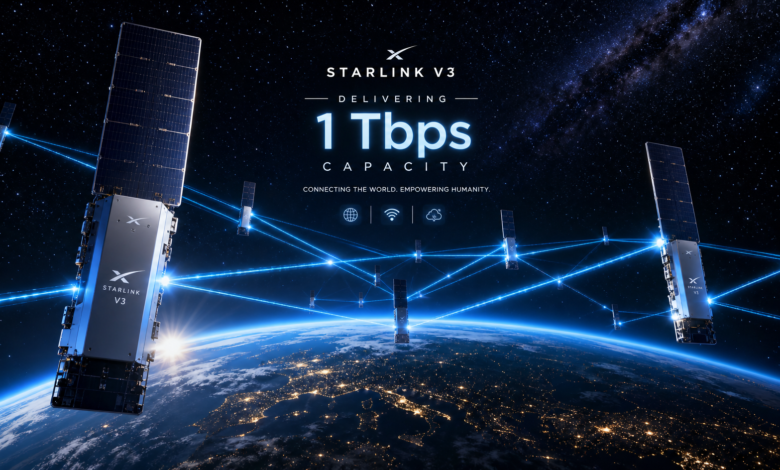
Starlink V3 satellites are set to mark a major step forward in satellite internet technology, bringing significantly higher data capacity, improved connectivity, and greater network efficiency to SpaceX’s growing global broadband system. Designed to deliver up to 1 terabit per second (Tbps) of downlink capacity per satellite, the new generation represents a substantial improvement over the previous V2 hardware and could help SpaceX serve millions of additional customers worldwide.
The upgrade comes as demand for high-speed internet continues to increase, particularly in remote communities, underserved regions, and areas where traditional broadband infrastructure remains limited. With larger satellites, advanced phased-array antennas, and high-capacity optical links, SpaceX is positioning its next-generation constellation to handle significantly more network traffic.
Starlink V3 Satellites: A Major Increase in Network Capacity
SpaceX’s next-generation Starlink V3 satellites are designed to deliver approximately 1 Tbps of downlink capacity and 160 Gbps of uplink capacity per spacecraft, according to the company’s published technical specifications.
The difference is particularly important because satellite broadband networks must distribute available bandwidth across large numbers of users. As more households, businesses, aircraft, ships, and remote facilities connect to Starlink, additional capacity becomes essential to maintaining network performance.
Rather than simply adding more satellites, SpaceX is increasing the amount of data each spacecraft can handle. This approach could improve the overall efficiency of the constellation while allowing the company to expand service in areas experiencing high demand.
Read Also:
Obsession: Low-Budget Horror Hit Sets Netflix Release Date for November 17
How Starlink V3 Compares With V2 Satellites
The move from V2 to V3 introduces substantial improvements in several technical areas, including bandwidth, antenna performance, and satellite-to-satellite communication.
The published specifications highlight the following differences:
| Feature | Starlink V2 | Starlink V3 |
|---|---|---|
| Downlink capacity | Baseline | 1 Tbps |
| Uplink capacity | Baseline | 160 Gbps |
| Downlink improvement | — | Approximately 10x |
| Uplink improvement | — | Approximately 22x |
| Phased-array beams | 192 downlink / 144 uplink | 2,048 in each direction |
One of the most significant upgrades involves the phased-array antenna system. V3 satellites support 2,048 downlink and uplink beams, compared with 192 downlink beams and 144 uplink beams on V2.
These additional beams allow satellites to direct network capacity more efficiently toward different areas and user terminals. The system can also adapt data distribution to changing demand, helping SpaceX serve densely populated locations without ignoring customers in less populated regions.
The new generation also features upgraded beamformer chips and satellite modems designed to process substantially more information. SpaceX says its next-generation modem technology supports approximately 64 times the throughput handled per modem chip compared with the previous generation.
Advanced Laser Technology Connects the Starlink Constellation
Another important part of the Starlink V3 upgrade is its optical inter-satellite communication system.
Each V3 satellite is equipped with six high-capacity space lasers, with each laser supporting a data rate of 400 Gbps. Together, these links provide up to 2.4 Tbps of theoretical optical inter-satellite link capacity.
These laser connections allow satellites to exchange information directly in orbit rather than relying exclusively on ground-based gateways. Data can travel across multiple satellites before reaching a gateway closer to its final destination.
This architecture is particularly valuable for international connectivity, ocean routes, remote regions, and locations where terrestrial infrastructure is difficult or expensive to build.
In addition to optical communication, V3 satellites include four quad-band radio-frequency backhaul antennas. SpaceX says this system supports up to 1.2 Tbps of RF backhaul capacity, more than eight times the capacity supported by the V2 generation.
The combination of optical and RF communication gives the constellation additional flexibility when routing traffic across the network.
It is important to distinguish these V3 specifications from the much larger laser figures discussed by Elon Musk in November 2026. Musk’s comments about next-generation 10 Tbps laser links and potentially around 100 lasers per satellite relate to ambitions for the future V4 generation, not the published V3 hardware specifications.
Starship Plays a Critical Role in Starlink V3 Deployment
The increased size and weight of V3 satellites create new launch requirements.
SpaceX plans to use its Starship launch system to deploy these larger spacecraft into low Earth orbit. Starship’s payload capacity is expected to make it possible to launch much larger batches of satellites in a single mission than the company’s existing Falcon 9 operations can typically accommodate.
According to SpaceX’s published network information, a single Starship deployment of V3 satellites is projected to add approximately 60 Tbps of downlink capacity to the network.
That would represent more than 20 times the capacity added by a typical Falcon 9 Starlink launch, highlighting why Starship is central to SpaceX’s long-term broadband expansion strategy.
SpaceX also confirmed in its October 2026 update that it had deployed its first 26 Starlink V3 satellites by the end of September. This marked an important transition from the development phase toward the initial deployment of the new satellite generation.
However, building a larger constellation will require more than launching satellites. SpaceX must also expand its ground infrastructure, manage orbital traffic, maintain reliable gateway connections, and ensure that user terminals can take advantage of the additional network capacity.
What Starlink V3 Means for Internet Speeds and Latency
The headline figures surrounding V3 may create the impression that individual Starlink customers will receive internet speeds approaching 1 Tbps. That is not what the satellite specifications mean.
The 1 Tbps figure represents the satellite’s overall downlink capacity, not the download speed available to a single household.
Actual customer speeds depend on several factors, including network congestion, geographic location, subscription plans, user equipment, available spectrum, and the number of customers sharing capacity within a coverage area.
SpaceX reported a median download speed of approximately 225 Mbps during peak hours for residential users as of March 31, 2026. The company also reported median network latency of approximately 25 milliseconds during that period.
V3 could help improve these results by increasing the amount of available bandwidth and allowing the network to distribute traffic more efficiently.
Its upgraded antennas and processing systems may also help reduce congestion in busy areas. Meanwhile, improved routing across optical links could support more efficient connections between distant locations.
Nevertheless, actual performance improvements will depend on how quickly SpaceX deploys V3 satellites and integrates them into its existing network. The new hardware should not be interpreted as a guarantee that every subscriber will immediately experience higher speeds or latency below 20 milliseconds.
Starlink’s Growing Network Serves Millions of Customers
The V3 rollout comes at a time when Starlink has already become one of the world’s largest satellite broadband networks.
SpaceX reported approximately 12 million Starlink subscribers at the end of June 2026, according to its second-quarter financial results. The company also stated in an October update that its constellation had grown beyond 11,000 satellites in low Earth orbit.
This scale gives SpaceX a significant foundation for introducing more advanced spacecraft and expanding its coverage.
The network serves residential customers, businesses, government organizations, maritime operators, and aviation companies. Its ability to provide broadband connectivity in locations without reliable fiber or mobile infrastructure remains one of its most important advantages.
As the constellation grows, additional satellite capacity could also help support applications that require more consistent connectivity, including cloud services, video streaming, remote operations, and enterprise communications.
However, the expansion will also increase the importance of orbital safety, spectrum coordination, and responsible satellite management. Operating thousands of spacecraft in low Earth orbit requires continuous monitoring and effective collision-avoidance systems.
Could Starlink V3 Challenge Traditional Broadband Infrastructure?
Starlink’s next-generation satellites could strengthen the company’s position in the global broadband market, particularly in regions where building fiber networks is expensive or impractical.
Traditional fiber infrastructure remains highly competitive in areas with established networks, offering high capacity and reliable performance. However, laying cables across oceans, mountains, deserts, and remote communities can require significant investment and lengthy construction projects.
Satellite internet offers a different approach. By expanding its constellation, SpaceX can provide connectivity across large geographic areas without requiring a physical cable to reach every customer.
V3’s higher capacity could make this model more competitive by allowing more users to share the network while supporting additional data-intensive applications.
Elon Musk has also discussed a future in which advanced optical links between satellites could compete with traditional undersea cable networks. Those comments relate to the broader development of future Starlink generations, particularly V4, and should be viewed as a long-term ambition rather than an established replacement for existing global internet infrastructure.
For now, Starlink V3 represents a major step toward increasing the capacity and efficiency of satellite broadband.
What Comes Next for Starlink?
SpaceX’s transition to V3 is part of a broader strategy to expand its satellite network and improve the performance of its global internet service.
The combination of higher-capacity spacecraft, advanced antennas, optical communication links, and Starship’s heavy-lift capabilities could significantly change how satellite broadband networks operate.
The first V3 deployments demonstrate that the next phase of Starlink’s expansion is moving forward. However, the full impact will depend on the pace of future launches, the integration of new satellites, and the company’s ability to translate greater orbital capacity into better service for customers.
As competition in satellite communications continues to develop, Starlink’s next-generation hardware could become one of the most important developments in the broadband industry.
For millions of users who depend on satellite connectivity, the real measure of success will not simply be the impressive capacity figures announced by SpaceX, but how effectively those improvements translate into faster, more reliable, and more accessible internet service.