Alibaba Bans Claude Code Over Security Concerns as AI Rivalry With Anthropic Intensifies

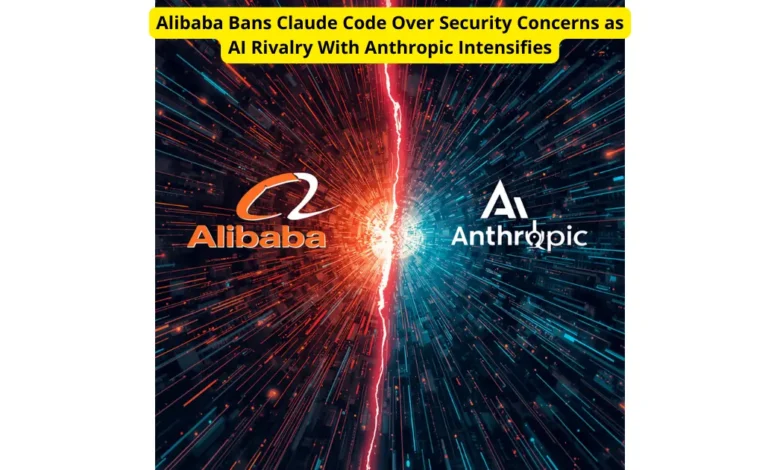
Alibaba bans Claude Code from its workplace environments beginning July 10, marking one of the most significant enterprise AI policy decisions of 2026. The reported internal directive comes as tensions between the Chinese technology giant and U.S.-based AI company Anthropic continue to escalate over security concerns, intellectual property disputes, and growing competition in the global AI race. According to multiple reports, Alibaba employees will transition to the company’s internally developed coding platform, Qoder, instead of Anthropic’s AI-powered programming assistant.
Alibaba Bans Claude Code Following Security Review and Internal Risk Assessment
According to people familiar with the internal policy, Alibaba classified Claude Code as a high-risk application for enterprise use after developers discovered mechanisms within the software capable of inspecting aspects of a user’s operating environment, including time zone settings and proxy-related information. Researchers also reported that the tool embedded subtle markers into prompts sent back to Anthropic’s servers using text encoding techniques that were difficult for users to detect.
Those findings quickly sparked debate throughout the developer community, particularly in China, where Claude Code had become one of the most popular AI coding assistants despite Anthropic’s restrictions on access from Chinese users and organizations.
Rather than allowing continued use while the concerns were investigated, Alibaba reportedly opted for a complete workplace ban effective July 10, directing engineering teams to migrate to its internally developed coding assistant, Qoder.
Read Also:
Windows Recall Privacy Concerns Threaten Windows 11 Security with Exploitable Hacker Honeypots!
WhatsApp Features Update: Active Contacts Indicator for iPhone and View-Once Texts
Anthropic Says the Detection Features Were Designed to Protect Its Models
Anthropic has acknowledged the existence of the detection mechanism but disputes the characterization that it functions as spyware or a hidden backdoor.
According to an Anthropic engineer, the feature was introduced as an experimental defensive measure in March to combat unauthorized account resellers and reduce large-scale model distillation efforts. The company says the system was intended to identify suspicious usage patterns rather than collect sensitive personal information.
Model distillation has become one of the most controversial issues in artificial intelligence, allowing developers to train smaller or competing AI systems using outputs generated by more advanced foundation models.
The Ban Follows Anthropic’s Allegations Against Alibaba
The timing of Alibaba’s decision is particularly notable because it comes only weeks after Anthropic accused parties linked to Alibaba of carrying out what it described as one of the largest AI model distillation campaigns it has encountered.
In a letter reviewed by Reuters, Anthropic alleged that operators associated with Alibaba used nearly 25,000 fraudulent accounts to generate approximately 28.8 million interactions with Claude between April and June 2026. According to Anthropic, the activity was intended to accelerate development of competing AI systems by extracting knowledge from Claude’s responses. Alibaba has not publicly accepted those allegations.
The dispute has become one of the highest-profile examples of how competition between leading AI developers is increasingly extending beyond product innovation into intellectual property protection and platform security.
Alibaba Pushes Developers Toward Qoder
With Claude Code reportedly prohibited inside Alibaba’s workplace environment, developers are being instructed to use Qoder, the company’s in-house AI programming platform.
The move reflects a broader shift taking place across China’s technology industry, where major firms are investing heavily in domestic AI ecosystems rather than relying on U.S.-developed models.
Companies including Alibaba, DeepSeek, Moonshot AI, and Zhipu continue expanding locally developed foundation models while reducing dependence on foreign AI services amid tightening export controls and increasing geopolitical tensions.
Why This Matters for Developers
For software engineers, the decision extends beyond a single coding assistant.
It highlights a growing reality in enterprise AI adoption: organizations are no longer evaluating AI tools solely on coding performance or productivity gains. Security architecture, compliance policies, data governance, and model ownership are becoming equally important when selecting AI development platforms.
As governments introduce stricter AI regulations and companies seek greater control over proprietary source code, enterprise adoption decisions are increasingly shaped by geopolitical risk as much as technical capability.
The Alibaba-Anthropic dispute may therefore represent more than an isolated corporate disagreement—it could signal how AI software procurement evolves for multinational organizations operating across different regulatory environments.
Discover more from Feenanoor
Subscribe to get the latest posts sent to your email.