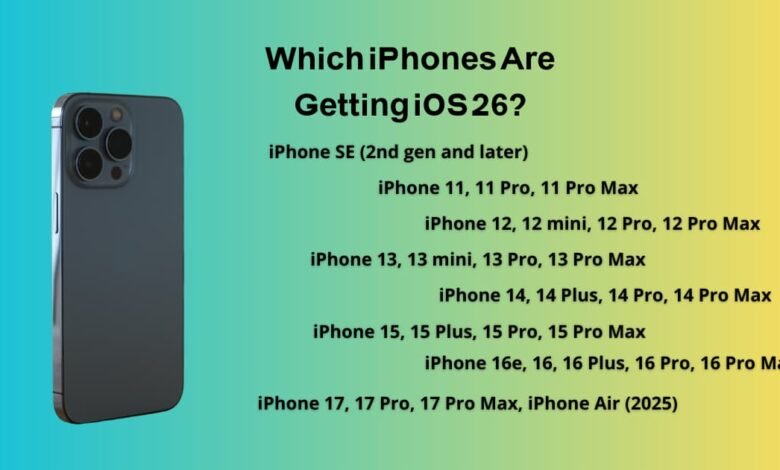
Which iPhones are getting iOS 26? iOS 26 brings a new design, Apple Intelligence features, and stronger privacy tools — but not every iPhone will get it. Here’s the full breakdown of supported devices, dropped models, and feature restrictions.
Which iPhones Are Getting iOS 26?
Apple has confirmed that iOS 26 will launch on September 15, 2025, as a free update. Devices eligible for the upgrade need at least an A13 Bionic chip or newer. This means that most iPhones from the iPhone 11 series onward will be supported. However, some older models will be left behind due to hardware limitations.

Full List of iPhones Supporting iOS 26
- iPhone SE (2nd gen and later)
- iPhone 11, 11 Pro, 11 Pro Max
- iPhone 12, 12 mini, 12 Pro, 12 Pro Max
- iPhone 13, 13 mini, 13 Pro, 13 Pro Max
- iPhone 14, 14 Plus, 14 Pro, 14 Pro Max
- iPhone 15, 15 Plus, 15 Pro, 15 Pro Max
- iPhone 16e, 16, 16 Plus, 16 Pro, 16 Pro Max
- iPhone 17, 17 Pro, 17 Pro Max, iPhone Air (2025)
iPhones Losing Support in iOS 26
Three popular iPhones are no longer supported:
- iPhone XR
- iPhone XS
- iPhone XS Max
These models use the A12 Bionic chip, which is not powerful enough to handle the advanced AI and system requirements in iOS 26.
Feature Comparison Across Supported iPhones
Not all iPhones that receive iOS 26 will unlock the same features. Some advanced functions, such as Apple Intelligence, Live Translation, and AI-driven camera tools, are limited to newer models.
| iPhone Models | iOS 26 Support | Apple Intelligence (AI Features) | Live Translation | Advanced Camera AI | Notes |
|---|---|---|---|---|---|
| iPhone SE (2nd & 3rd Gen) | ✅ Full OS | ❌ Not Supported | ❌ Not Supported | ❌ Not Supported | Basic features only |
| iPhone 11 / 11 Pro / 11 Pro Max | ✅ Full OS | ❌ Not Supported | ❌ Not Supported | ❌ Not Supported | Runs iOS 26 but misses most AI tools |
| iPhone 12 / 12 mini / 12 Pro / 12 Pro Max | ✅ Full OS | ⚠️ Limited | ❌ Not Supported | ❌ Not Supported | Some AI tasks missing |
| iPhone 13 / 13 mini / 13 Pro / 13 Pro Max | ✅ Full OS | ⚠️ Limited | ⚠️ Partial | ❌ Not Supported | Better than iPhone 12 but not full |
| iPhone 14 / 14 Plus / 14 Pro / 14 Pro Max | ✅ Full OS | ⚠️ Limited | ⚠️ Partial | ⚠️ Limited | Stronger AI, but not like 15/16/17 |
| iPhone 15 / 15 Plus | ✅ Full OS | ⚠️ Limited | ✅ Supported | ⚠️ Limited | Solid mid-tier support |
| iPhone 15 Pro / 15 Pro Max | ✅ Full OS | ✅ Full Support | ✅ Supported | ✅ Supported | First big jump in Apple Intelligence |
| iPhone 16 Series (16e / 16 / 16 Plus / 16 Pro / 16 Pro Max) | ✅ Full OS | ✅ Full Support | ✅ Supported | ✅ Supported | Optimized for AI |
| iPhone 17 / 17 Pro / 17 Pro Max / iPhone Air (2025) | ✅ Full OS | ✅ Full Support | ✅ Supported | ✅ Supported | Best performance, all features |
Why Older iPhones Were Dropped
Apple’s decision to end support for iPhone XS, XS Max, and XR is tied to the limitations of the A12 Bionic chip. With iOS 26 pushing AI processing, translation engines, and live rendering, Apple is focusing on devices that can run these features without compromise.
What This Means for Users
- If you own an iPhone 11 or newer, you’ll still get iOS 26.
- For the best AI features, like Apple Intelligence and advanced camera tools, you’ll need at least an iPhone 15 Pro or newer.
- If you’re still on an XS, XS Max, or XR, you’ll miss iOS 26 entirely, meaning no future features or security updates.
iOS 26 marks a turning point for Apple. It introduces futuristic features, but also leaves behind older devices. For everyday users, most improvements will still be felt on iPhone 11 and above. But for those who want the full AI-powered experience, upgrading to iPhone 15 Pro or newer is the clear path forward.
FAQ: iOS 26 Supported iPhones
1. Will iPhone XR get iOS 26?
No. iPhone XR, along with XS and XS Max, will not support iOS 26.
2. Do all iPhones with iOS 26 get Apple Intelligence?
No. Only iPhone 15 Pro and later models have full AI support.
3. Is iPhone SE (2nd gen) still supported?
Yes, it gets iOS 26, but with limited features.
4. Which iPhone is best for full iOS 26 experience?
The iPhone 16 and iPhone 17 series offer the complete package, including every AI and camera feature.
Discover more from Feenanoor
Subscribe to get the latest posts sent to your email.