Topical Authority: Why Google Now Prefers Experts, Not Generalists

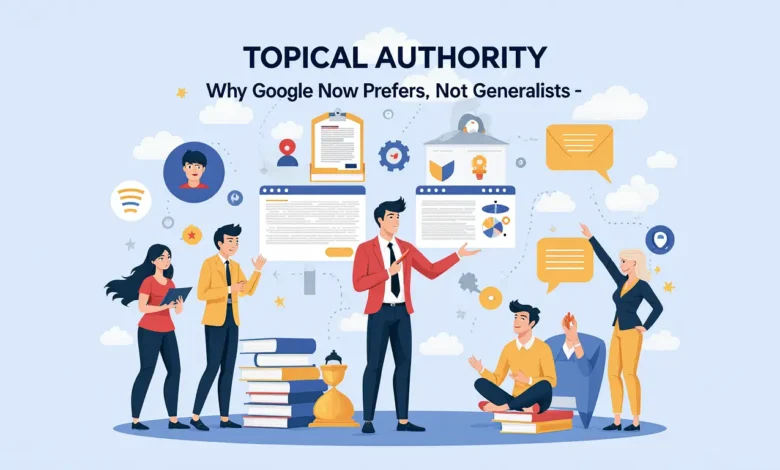
Topical Authority explains why Google increasingly rewards websites that demonstrate deep, consistent expertise in a specific subject area rather than those that publish shallow content across many unrelated topics. As Google’s algorithms evolve, authority is no longer built by volume alone, but by relevance, depth, and sustained topical focus. This shift has changed how successful SEO strategies are built in 2025 and beyond.
Topical Authority and the Shift in Google’s Ranking Philosophy
For years, SEO revolved around keywords, backlinks, and publishing frequency. While these factors still matter, Google’s core systems now emphasize understanding who truly knows a topic. Topical Authority reflects Google’s ability to evaluate whether a website has comprehensive, trustworthy coverage of a subject, supported by internal consistency and real expertise.
Google no longer asks only: Does this page answer the query?
Instead, it asks: Is this site a reliable source on this entire topic?



This change explains why expert-driven niche sites are outperforming large general blogs that cover everything from technology to health to finance with limited depth.
What Exactly Is Topical Authority?
Topical Authority is the perceived expertise a website builds by covering all meaningful subtopics within a defined niche in a structured and consistent way. It is not a single ranking factor, but a result of how Google connects content, context, and credibility.
A site with strong topical authority:
- Focuses on a limited number of related topics
- Covers those topics comprehensively
- Publishes content that naturally interlinks
- Demonstrates experience, depth, and continuity over time
Google’s systems recognize patterns. When multiple high-quality articles consistently support one another within a topic, Google learns to associate that site with expertise in that area.
Topical authority is one piece of a much larger SEO transformation. To understand how this concept fits into the modern search landscape, it helps to start with the fundamentals outlined in What Is SEO in 2025? A Complete Guide to Search Optimization for Sustainable Growth, which explains how search optimization has evolved beyond keywords and links into a sustainable, system-driven approach.
Why Google Prefers Experts Over Generalists
1. Better User Satisfaction
Users searching today want accurate, in-depth answers. A generalist site often provides surface-level explanations, while expert sites anticipate follow-up questions and address them proactively. Google measures satisfaction indirectly through engagement signals, query refinement behavior, and long-term trust indicators.
2. Algorithmic Understanding of Context
Modern search is semantic, not keyword-based. Google’s AI models understand relationships between concepts. Expert sites naturally use consistent terminology, advanced context, and topic-specific language that reinforces relevance.
A generalist site may rank for isolated keywords, but an expert site ranks across clusters of related queries.
3. E-E-A-T Is Easier to Demonstrate in a Niche
Experience, Expertise, Authoritativeness, and Trustworthiness are easier to establish when a site stays within a defined subject area. Publishing hundreds of articles on one niche builds stronger signals than publishing a few articles across many niches.
Expert sites develop:
- Consistent editorial tone
- Recognizable subject mastery
- Clear audience alignment
Google notices this consistency.
Topical Authority vs Keyword Authority
Keyword authority focuses on ranking individual pages for individual terms. Topical authority focuses on ranking entire domains for entire subject areas.
Keyword-driven strategy:
- Targets isolated phrases
- Produces disconnected articles
- Relies heavily on backlinks
Topical authority-driven strategy:
- Targets search intent clusters
- Builds content hierarchies
- Relies on internal relevance and depth
In practice, keyword authority can bring short-term wins. Topical authority builds long-term dominance.
How Google Identifies Topical Authority
Google does not rely on a single signal. Instead, it evaluates patterns across the site.
Content Coverage Depth
Does the site cover beginner, intermediate, and advanced aspects of the topic?
Does it answer related questions users typically ask next?
Incomplete coverage signals limited expertise.
Internal Linking Structure
Expert sites naturally connect related articles. Internal links reinforce topic relationships and help Google understand content architecture.
Random or sparse internal linking weakens topical signals.
Publishing Consistency Within One Topic
Authority grows when a site repeatedly publishes within the same niche over time. Sudden topic switching dilutes relevance.
Consistency tells Google: this site is committed to this subject.
Semantic Relevance and Language Use
Expert content uses precise terminology, nuanced explanations, and contextually accurate language. This is difficult to fake at scale.
Google’s models recognize authentic topical fluency.
User Engagement Patterns
When users stay longer, explore multiple related articles, and return to the site, Google receives confirmation that the site satisfies topical intent.
Why Generalist Sites Are Losing Visibility
Many broad blogs relied on publishing large volumes of content targeting trending keywords. This approach is becoming less effective because:
- Content lacks depth
- Topics are unrelated
- Internal linking is weak
- Expertise signals are diluted
Even high-authority domains are seeing ranking declines in areas where they lack topical focus. Authority is no longer transferable across unrelated niches.
Building Topical Authority: The Strategic Framework
1. Define a Clear Core Topic
Authority begins with clarity. A site must clearly define what it stands for. The narrower the core topic, the faster authority grows.
Instead of:
- “Technology news”
Focus on:
- “Artificial intelligence tools for content creators”
- “Mobile device reviews and performance analysis”
- “SEO strategy for publishers and media websites”
Clarity accelerates recognition.
2. Build Topic Clusters, Not Random Articles
Each main topic should be supported by multiple subtopics that cover:
- Definitions
- Use cases
- Comparisons
- Advanced analysis
- Common problems and solutions
This structure mirrors how humans learn and how Google maps topics.
3. Strengthen Internal Linking Intentionally
Internal links should connect conceptually related articles, not randomly. Pillar pages should link to supporting articles, and supporting articles should reinforce the pillar.
This creates a topical graph that Google can easily interpret.
4. Maintain Editorial Consistency
Authority is not built by one viral article. It is built through sustained, focused publishing. Over time, Google begins to associate the domain with the topic automatically.
5. Update and Expand Existing Content
Expert sites evolve. Updating articles with new insights, expanded explanations, and current examples reinforces authority signals and prevents content decay.
Topical Authority and the Future of SEO
As AI-driven search continues to evolve, topical authority will become even more important. Search engines aim to surface trusted sources, not just optimized pages.
In AI-powered search experiences, Google increasingly relies on sources that demonstrate:
- Consistent subject mastery
- Reliable historical performance
- Clear topical identity
Websites that lack focus will struggle to remain visible.
Why Topical Authority Is a Competitive Advantage
Topical authority compounds over time. Once established, it becomes easier to rank new content within the same niche, even with minimal backlinks.
Expert sites benefit from:
- Faster indexing
- Higher baseline rankings
- Stronger trust signals
- Better resilience during algorithm updates
This makes topical authority one of the most defensible SEO strategies available today.
Conclusion
Topical Authority is not a trend; it is a fundamental shift in how Google evaluates quality and relevance. In 2025, Google prefers experts because experts deliver better user experiences, clearer signals, and more trustworthy information.
Generalists may still exist, but dominance belongs to focused, authoritative publishers who commit to mastering their niche. Building topical authority requires patience, structure, and discipline—but the long-term rewards far outweigh short-term keyword wins.
Websites that choose depth over breadth are not just aligning with Google’s preferences—they are aligning with users’ expectations.
FAQ
What is Topical Authority in SEO?
Topical Authority is the trust and expertise a website builds by comprehensively covering a specific subject area in a structured and consistent way.
Is Topical Authority more important than backlinks?
Backlinks still matter, but topical authority can significantly reduce reliance on external links by strengthening internal relevance and trust signals.
Can a new website build topical authority?
Yes. New sites can build topical authority faster than old generalist sites by focusing narrowly and publishing deeply within one niche.
Does topical authority apply to all niches?
Yes. It applies to technology, health, finance, news, education, and any topic where depth and accuracy matter.
How long does it take to build topical authority?
It depends on competition and consistency, but meaningful signals typically begin to appear within several months of focused publishing.
Discover more from Feenanoor
Subscribe to get the latest posts sent to your email.