
Regulatory Artificial Intelligence: Could Anthropic’s Claude Threaten the Future of GPT-5?

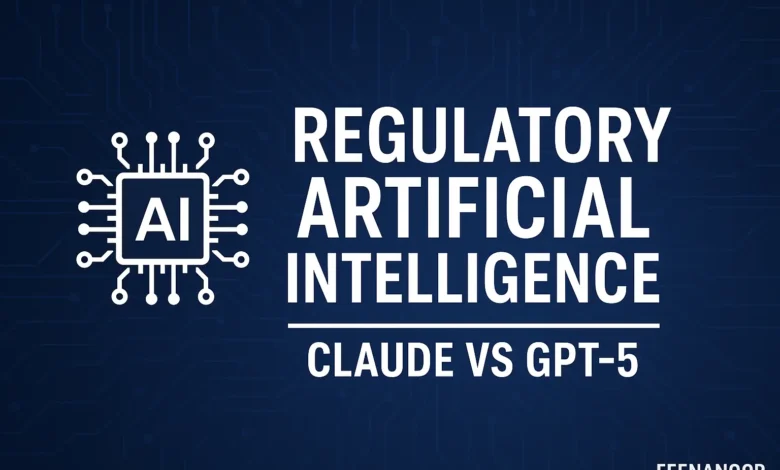
Regulatory Artificial Intelligence is rapidly emerging as the most critical factor shaping the next era of machine intelligence. As the AI race intensifies, Anthropic’s Claude series has positioned itself not just as a technical rival to OpenAI’s GPT-5, but as a regulatory-driven model redefining what “safe intelligence” really means — and possibly threatening the dominance of GPT itself.
table of contents
Regulatory Artificial Intelligence and the Claude Model
Regulatory Artificial Intelligence — or R-AI — represents a paradigm shift in how AI systems are built, governed, and audited. It’s no longer just about bigger models or faster inference speeds; it’s about ethical scalability, alignment, and policy compliance at every layer of development.
Anthropic, the company behind Claude, has pioneered this concept. Founded by ex-OpenAI researchers who were deeply concerned about the unchecked power of large-language models, Anthropic focused on one question:

How can we make AI systems that think responsibly, not just intelligently?
Their answer was Constitutional AI — the foundation of Claude. This methodology embeds ethical reasoning directly into the model’s architecture, using guiding principles to steer its decision-making rather than relying solely on external moderation.
In contrast, OpenAI’s GPT-5 — while more powerful and data-rich — continues to rely on post-training filters and reactive safety protocols, leaving it open to policy fluctuations, bias concerns, and public scrutiny.
Read Also : How Unique Content Can Leverage AI Summaries to Dominate Search Results
Claude’s Strategic Position in the Regulatory Race
Anthropic’s vision of regulatory intelligence is now intersecting with global efforts to control AI development. Its collaboration with the Japan AI Safety Institute, the UK’s AI Safety Summit, and the U.S. Department of Commerce reflects a strategic positioning: Claude isn’t just competing on performance — it’s competing on trust.
This is crucial for enterprises, governments, and public-sector deployments where compliance and transparency are non-negotiable. Claude’s internal safety architecture makes it naturally suitable for regions tightening their AI regulations, such as the European Union, Japan, and soon GCC countries moving toward responsible tech governance.
In essence, Anthropic is building the AI that regulators will approve first — a decisive edge in a future where safety equals scalability.
The Hidden Challenge for GPT-5
While GPT-5 dominates in raw capability — multimodal reasoning, advanced contextual memory, and near-human generation — it faces an existential paradox: the more powerful it becomes, the harder it is to regulate.
OpenAI’s strength is innovation speed. Anthropic’s strength is compliance and alignment. As governments race to establish legal frameworks for AI, the model that aligns first with those frameworks may win by default.
Imagine a future where GPT-5 cannot be deployed in certain countries due to opaque training data or lack of accountability reports — while Claude, fully transparent and policy-aligned, becomes the “officially sanctioned” AI.
That’s not science fiction. It’s already happening. Japan and the EU are crafting certification systems for “trustworthy AI,” and Anthropic’s Claude models are front-runners for compliance.
Technical Edge vs. Ethical Edge
Claude’s “ethical edge” does not mean it’s technically inferior. On the contrary, Anthropic has tapped Google Cloud’s massive TPU infrastructure, consuming over one gigawatt of computing power to train next-generation Claude models.
Combined with Amazon’s AI infrastructure project, which deploys over a million custom chips for Claude’s scaling, Anthropic is equipping itself to match GPT-5’s raw computational might.
However, the key differentiator remains governance. GPT-5 might outscore Claude in performance benchmarks — but Claude may outperform GPT-5 in policy longevity, especially in enterprise and governmental markets where trust and accountability are more valuable than speed or creativity.
Ethics as a Business Model
Anthropic has turned ethics into a product feature. By transforming regulatory compliance into a technological advantage, it’s building a model that’s not only “safe” but also marketable as a compliant, future-proof solution.
This makes Claude particularly appealing for:
- Banks and financial institutions worried about AI liability.
- Healthcare sectors needing transparent data pipelines.
- Educational systems seeking fact-driven assistance.
- Governments enforcing responsible AI standards.
As GPT-5 continues to operate at the frontier of creativity and technical brilliance, Claude quietly solidifies its role as the ethical AI for institutions — slow to evolve, but impossible to ban.
Feenanoor’s Analysis: The True Threat to GPT-5
The real threat isn’t that Claude will surpass GPT-5 in intelligence — it’s that Claude will outlast GPT-5 in legality.
OpenAI’s approach depends on maintaining an uneasy balance between innovation and control. Anthropic, by contrast, is embedding control into innovation itself. This inversion of priorities could become the defining factor of the AI decade.
If AI becomes as regulated as aviation or pharmaceuticals, the company that “complies by design” — not by adjustment — will dominate. Claude is that company’s product.
The future of AI will not be decided by who builds the smartest model, but by who builds the most trusted one. Anthropic’s Claude represents the rise of Regulatory Artificial Intelligence, where safety, compliance, and human alignment are not afterthoughts but the core architecture itself.
GPT-5 might continue to lead the innovation curve, but Claude could very well define the legal and ethical framework that all future models — including GPT-6 — must obey.
Frequently Asked Questions (FAQ)
1. What is Regulatory Artificial Intelligence?
It’s the concept of designing AI systems that inherently comply with ethical and governmental standards — ensuring responsible usage and minimizing societal risks.
2. How does Claude differ from GPT-5 in safety?
Claude uses Constitutional AI principles for self-regulation, while GPT-5 relies more on post-training moderation and user policy enforcement.
3. Could Claude replace GPT-5 in enterprises?
Possibly — especially in industries requiring transparency, audit trails, and explainable outputs.
4. Is Anthropic ahead of OpenAI in compliance?
Yes. Anthropic’s partnerships with global safety institutions give it a clear head start in building AI that aligns with upcoming international regulations.