

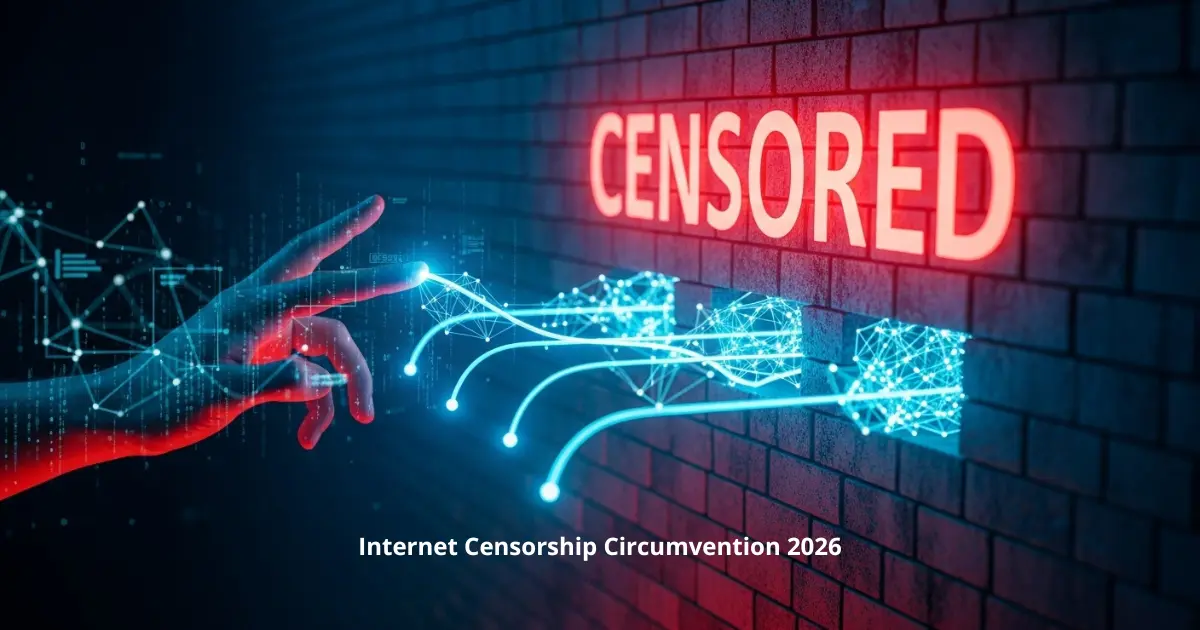
The digital world in early 2026 has entered a high-stakes “AI arms race” between state censors and privacy developers. As governments implement increasingly sophisticated filters, the tools used to bypass these restrictions have evolved from simple tunnels into intelligent, adaptive systems. The focus has shifted from merely hiding data to “blending” it into the noise of ordinary internet traffic, making Internet Censorship Circumvention 2026 a battleground of mathematical resilience and machine learning.
Strategic Breakthroughs in Internet Censorship Circumvention 2026 and AI Obfuscation
The most significant development in Internet Censorship Circumvention 2026 is the arrival of Dynamic Obfuscation. While state censors now use Deep Packet Inspection (DPI 2.0) to identify the behavioral fingerprints of encrypted traffic, modern tools have integrated AI-driven traffic shaping. Protocols like Shadowsocks and Trojan have evolved to mimic “white-listed” traffic, such as Zoom calls or Netflix streaming. This mimicry is so convincing that automated filters cannot distinguish restricted data from legitimate economic activity, ensuring that the economy remains functional while privacy is maintained.
Read Also: Google Password Manager and Gmail 2026
Satellite Connectivity and the End of ISP Shutdowns
A major breakthrough in 2025 and 2026 is the expansion of Direct-to-Cell satellite technology. Standard LTE and 5G smartphones can now connect directly to satellites, such as Starlink, for basic messaging and emergency data without the need for a ground dish. This serves as a vital “kill-switch” antidote, allowing activists and citizens in conflict zones to maintain connectivity even when national ISPs are completely severed by local authorities.



The Rise of Mixnets and Metadata Privacy
Traditional VPNs are under heavy fire; by early 2026, some jurisdictions have banned over 400 individual services. This has led to the rise of “Mixnets” like Nym. Unlike a standard VPN that uses a single tunnel, a Mixnet breaks data into identical packets, shuffles them with “dummy traffic,” and sends them through multiple nodes. This makes it mathematically nearly impossible for censors to perform metadata analysis or traffic correlation, effectively neutralizing state-level surveillance.
Key Features of 2026 Circumvention Tools
- Encrypted Client Hello (ECH): Widely adopted in 2026, this protocol encrypts the initial handshake, preventing censors from seeing which domain a user is visiting.
- Platform-Based Proxies: Apps like Signal and Telegram now feature “auto-proxy” rotation, ensuring zero downtime even during intense blocking phases.
- Stealth Encryption: New “deniable” tools leave no trace on a device, protecting users in regions where using circumvention software is criminalized.
- Splinternet Resilience: Tools designed specifically to tunnel through isolated national networks or “Sovereign Internets.”
How to Navigate the 2026 Digital Landscape
To maintain access to the global web, users must move beyond legacy VPNs. The most effective strategy involves using multi-layered tools that support ECH and AI traffic shaping. It is recommended to keep “stealth” proxies pre-configured on devices and to utilize satellite-messaging apps as a secondary backup. As states move to criminalize the use of unauthorized encryption, selecting tools that offer “plausible deniability” has become a standard safety procedure for privacy-conscious users in restricted regions.
Article Summary
The era of Internet Censorship Circumvention 2026 is defined by resilience and AI integration. We analyzed the shift from VPNs to Mixnets, the role of direct-to-cell satellite connectivity in bypassing ISP shutdowns, and how new protocols like ECH are protecting user metadata. The focus in 2026 is no longer just on encryption, but on blending restricted traffic with ordinary data to evade AI-driven state filters.
FAQ
Q1: Why are traditional VPNs failing in 2026?
A: State censors now use DPI 2.0 and machine learning to recognize the unique patterns of VPN traffic, allowing them to block services based on behavior rather than just IP addresses.
Q2: What is a Mixnet, and how is it different from a VPN?
A: A VPN uses a single encrypted tunnel, while a Mixnet fragments and shuffles your data with “noise” through various nodes, making it impossible to analyze metadata.
Q3: Can my phone connect to a satellite without a dish in 2026?
A: Yes, through Direct-to-Cell technology, standard modern smartphones can now connect to satellite constellations for emergency data and messaging when local networks are down.
Discover more from Feenanoor
Subscribe to get the latest posts sent to your email.