



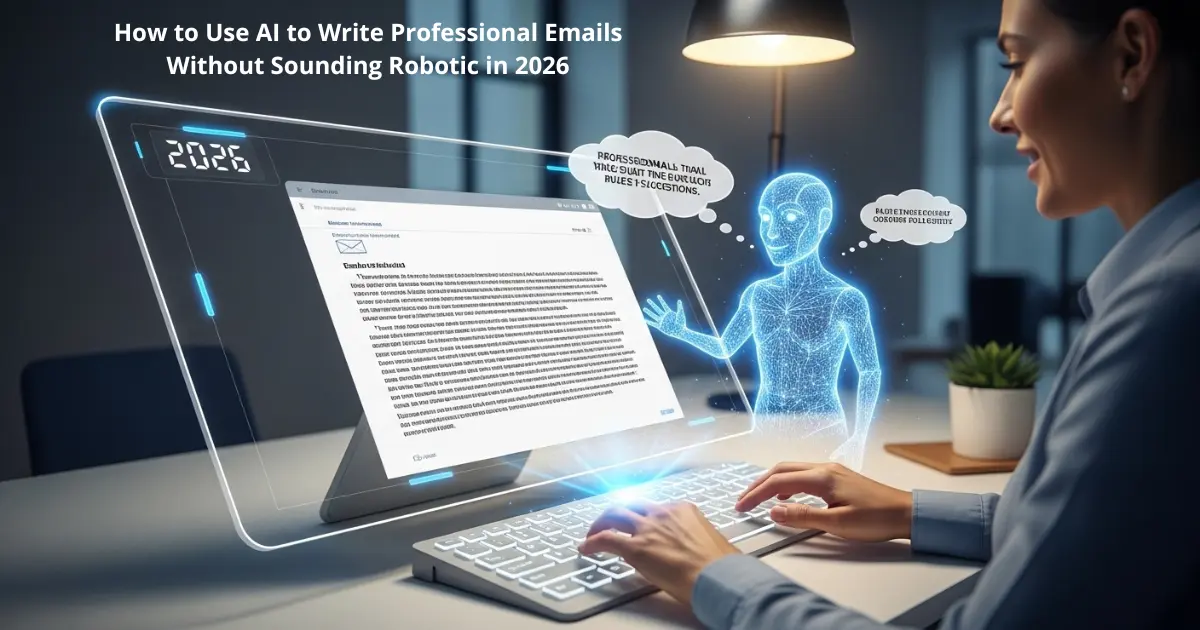
How to use AI to write professional emails without sounding robotic is no longer a productivity hack. In 2026, it’s a career skill. Across the United States—from finance teams in New York to SaaS founders in Austin—professionals are using AI daily. The difference between those who benefit and those who damage their credibility comes down to one thing: control.
Email is still the backbone of American business communication. Deals are opened, negotiated, delayed, and closed in inboxes. Promotions are influenced by tone. Client retention depends on clarity. And now, everyone knows what AI-generated writing sounds like.
The question isn’t whether to use AI. The real question is how to use it without sounding like everyone else who copied and pasted a generic draft.
This guide breaks down exactly how high-performing professionals are doing it right.
Why “Robotic Tone” Is Now a Business Liability
In 2026, managers can detect AI fingerprints instantly. Overly polished transitions. Suspiciously symmetrical paragraphs. Inflated phrases like “delve into,” “unlock opportunities,” or “in today’s fast-paced world.”
These signals create subtle distrust.
Not because AI is unethical—but because generic language suggests minimal effort. In high-stakes environments like venture capital, enterprise sales, consulting, or law, perception shapes authority.
Executives across U.S. markets increasingly describe what they call “AI fatigue.” When every email sounds structured the same way, differentiation disappears. And differentiation is influence.
If your message feels templated, you lose leverage.
Read Also:
Best Way to Learn JavaScript use 3w School
Technical Solutions: A Complete Guide to Fixing Website, SEO, and Digital Performance Issues
WiFi Not Working? Common Causes and Real Fixes That Actually Work
Step One: Stop Asking AI to “Write.” Start Asking It to “Perform.”
Most people fail before they begin. They type:
“Write an email to my manager.”
That guarantees a generic response.
Instead, define a role and context.
For example:
“Act as a senior operations director with 12 years of experience. Write a confident but concise follow-up email to a client who requested pricing details. Keep it direct. Avoid buzzwords. Use clear American business English.”
That instruction changes everything.
When you assign identity, seniority, tone, and constraints, AI produces writing aligned with real-world expectations. This technique—often called role prompting—is widely used in executive productivity circles across the U.S.
AI responds to specificity. The more precise the frame, the more human the output feels.
Step Two: Inject Context AI Cannot Invent
The biggest giveaway of robotic writing is vagueness.
Real professionals reference real moments.
Instead of asking for a “follow-up email,” provide anchors:
Mention last Thursday’s call.
Mention the Q2 roadmap discussion.
Mention the delayed shipment due to weather in Chicago.
Mention the investor’s concern about burn rate.
These details cannot be fabricated convincingly. They must come from you.
Context transforms structure into authenticity.
In American business culture, especially in client-facing industries, continuity signals competence. Emails that reference shared history feel personal—even when AI assists in drafting.
Step Three: Eliminate Corporate Poetry
AI loves dramatic language. Humans don’t.
If you want natural tone, instruct the system to avoid:
Overly dramatic verbs.
Metaphors.
Buzzwords.
Polished but empty transitions.
Ask for short sentences. Clear verbs. Straightforward phrasing.
For example, instead of:
“We are excited to unlock transformative synergies moving forward.”
You want:
“Looking forward to reviewing this together next week.”
Directness wins in American markets. Especially in sales, consulting, and startup ecosystems where time is currency.
Step Four: Rewrite for Rhythm, Not Grammar
AI produces balanced paragraphs. Humans don’t.
To break mechanical patterns, deliberately adjust rhythm. Combine longer explanatory sentences with shorter ones. Add a brief conversational line. Use natural closings.
Read the draft out loud. If it sounds like a press release, it needs revision.
High-level executives often prefer writing that sounds like how they speak in meetings—clear, measured, slightly conversational.
Rhythm signals humanity.
Step Five: Add a Controlled Imperfection
This is where professionals separate themselves from casual users.
AI drafts often feel too clean. Too symmetrical. Too complete.
Introduce subtle variation.
Rephrase one sentence naturally.
Add a short, spontaneous line at the end.
Include a quick clarifying question.
For example:
“Let me know if Thursday still works on your end.”
Small human touches reduce artificial predictability.
In competitive U.S. environments, authenticity beats perfection.
Before vs. After: What Humanized AI Looks Like
Here’s a simplified comparison.
Typical AI Output
“Dear John,
I hope this message finds you well. I am writing to follow up regarding our previous discussion about the Q2 initiative. Please let me know your availability at your earliest convenience.”
Technically correct. Emotionally flat.
Humanized Version
“John,
Following up on our Q2 conversation last Thursday.
If Thursday at 2 PM still works, I’ll send over the updated numbers beforehand. If not, happy to adjust.
Appreciate it.”
Shorter. Specific. Natural. Confident.
Same purpose. Different impact.
The Human-in-the-Loop Workflow Used by Top Performers
The most effective professionals do not outsource thinking. They use AI as a structured first draft engine.
Their workflow looks like this:
They define role and tone clearly.
They inject real context.
They remove inflated language.
They rewrite for rhythm.
They send only after a final human pass.
AI handles speed and structure. Humans handle judgment.
This hybrid approach is now common across remote-first American companies where communication volume is high and time is limited.
Why This Matters More in 2026
AI is everywhere. That means the advantage no longer comes from using it. The advantage comes from using it well.
Email influences hiring decisions. Funding approvals. Contract negotiations. Promotions.
If your communication feels automated, you blend into noise.
If it feels intentional, you stand out.
The American workplace is increasingly competitive and increasingly digital. Mastering AI-assisted communication is not optional—it’s leverage.
Practical Prompt Template You Can Use Immediately
Here is a structure that consistently produces natural results:
“Act as a [role] with [years] of experience. Write a concise email to [recipient type] about [specific topic]. Reference [real context detail]. Use direct American business English. Avoid buzzwords and dramatic phrasing. Vary sentence length. Keep it confident but approachable.”
Then edit.
Always edit.
The Bigger Shift in American Tech Culture
The national conversation has shifted from fascination to strategy.
Professionals are asking:
How do I protect my job from automation?
How do I maintain credibility in a digital-first world?
How do I stay efficient without losing authenticity?
Using AI to write professional emails without sounding robotic sits at the center of that shift.
It is not about replacing your voice. It is about amplifying it—without sacrificing clarity or trust.
The tool is powerful. But the judgment remains yours.
Frequently Asked Questions
How do I make AI-generated emails sound more natural?
Define a specific role and tone, inject real context, remove buzzwords, and always revise for rhythm before sending.
What are the biggest red flags of robotic writing?
Overly balanced paragraphs, dramatic vocabulary, generic openings, and absence of specific references to shared experiences.
Is it safe to use AI for sensitive business communication?
Yes, if you verify facts, adjust tone personally, and avoid sharing confidential data in unsecured tools.
Can AI replace professional writing skills?
No. AI accelerates drafting. Strategic communication and emotional nuance remain human competencies.
Does this approach work in remote-first American companies?
Yes. It enhances clarity and consistency across distributed teams while preserving personal tone.