

How to Make Money from eBooks Without Being a Writer: A Realistic Digital Income Model

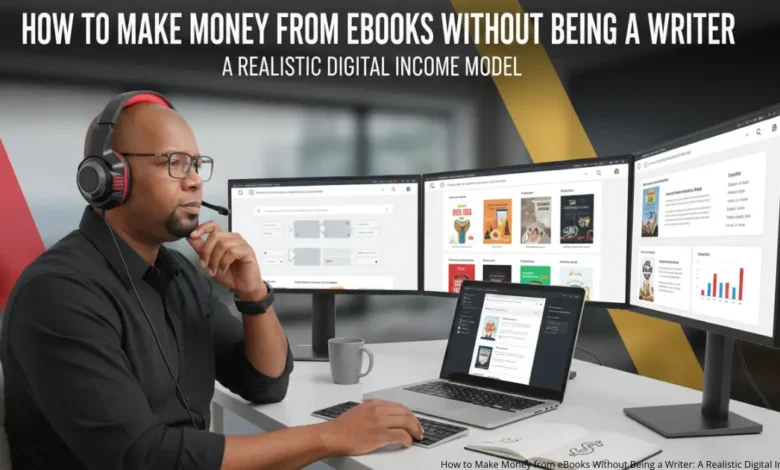
How to make money from eBooks without being a writer is no longer a theoretical concept or a marketing exaggeration. In today’s digital economy, writing skills are not the main barrier to entering the eBook market. What truly matters is understanding demand, structuring information, and executing a viable digital product strategy. Thousands of people generate consistent income from eBooks without writing a single page themselves, because they approach eBooks as a business model, not a literary pursuit.
Many beginners assume that selling eBooks requires creativity, storytelling talent, or years of writing experience. This assumption prevents them from starting. In reality, most profitable eBooks are not novels or artistic works. They are problem-solving tools designed to educate, guide, or simplify complex topics. Readers are not paying for writing talent; they are paying for clarity, structure, and solutions.
Understanding the eBook Business Beyond Writing
An eBook is best understood as a digital information product. Like online courses, templates, or guides, its value comes from usefulness rather than authorship. The market rewards books that save time, reduce confusion, or offer actionable insight. Whether the creator personally wrote every sentence is largely irrelevant to the buyer.



When you shift your mindset from “author” to “publisher,” the opportunity becomes clear. Your role is to identify a problem, define a solution, and package that solution in a format people are willing to buy. Writing is only one possible execution method, not a requirement.
Choosing Profitable eBook Ideas Without Writing Experience
Successful eBooks start with demand, not creativity. The most profitable topics usually exist in areas where people actively seek guidance, improvement, or shortcuts. These include personal finance, freelancing, digital skills, productivity, online business, health basics, and specialized how-to knowledge.
The strength of these topics is that they rely on practical value, not narrative style. Readers want direct answers, frameworks, and step-by-step clarity. If you can research a topic properly and understand what the audience struggles with, you already have the foundation for a profitable eBook.
Make Money Online: Real Strategies That Work in 2025
Creating an eBook Without Writing It Yourself
This is where most non-writers gain leverage. You are not required to produce the content personally. Instead, you manage the creation process.
One common approach is hiring freelance writers. With a clear outline and defined expectations, a professional writer can execute the content while you maintain editorial control. Your responsibility becomes quality assurance and structure, not authorship.
Another widely used method is leveraging artificial intelligence responsibly. AI tools can help generate drafts, summarize research, and organize ideas. When combined with human review and logical structuring, AI becomes a productivity multiplier rather than a shortcut. The key is supervision and refinement, not blind automation.
A third approach involves reorganizing existing knowledge. Many eBooks succeed by compiling scattered information into a single, well-structured resource. The value lies in organization and simplification, not originality. As long as the content is legal, ethical, and adds clarity, this model remains effective.
Why Readers Don’t Care Who Wrote the Book
Digital readers are goal-oriented. They buy eBooks to solve problems, learn faster, or gain insight. Very few buyers investigate the author’s background unless the topic requires formal authority. In most practical niches, usefulness outweighs identity.
In fact, concise, neutral, and outcome-focused writing often performs better than personality-driven content. Many readers prefer straightforward explanations without storytelling or personal anecdotes. This preference works in favor of non-writers who prioritize structure and clarity.
Pricing eBooks for Realistic Profit
One of the biggest misconceptions is that eBooks must be cheap to sell. In reality, specialization justifies pricing. A focused eBook that addresses a specific problem can be priced higher than a general guide and still convert well.
Because eBooks have no printing, shipping, or inventory costs, profit margins are extremely high. Even modest sales volumes can generate meaningful income when pricing aligns with perceived value.
The goal is not mass sales, but the right audience. A well-positioned eBook selling consistently to a targeted niche often outperforms generic low-priced products.
Selling eBooks Without Personal Branding or Visibility
One of the strongest advantages of this model is that it does not require personal exposure. eBooks can be sold through blogs, search traffic, email lists, marketplaces, and educational content without revealing identity or building a public persona.
Marketing focuses on content relevance, not the creator. This makes the model scalable and repeatable. Once the system works, it can be expanded with additional books, updates, or related products.
Turning eBooks into Long-Term Digital Assets
An eBook should not be viewed as a one-time product. It can serve as the foundation for a broader digital ecosystem. Many creators use eBooks as entry points into premium products, memberships, or services.
Over time, a well-optimized eBook becomes a digital asset that continues generating income with minimal maintenance. This long-term value is what makes the model especially attractive to non-writers.
The Real Challenges and How to Overcome Them
The main obstacle in this business is not writing skill, but execution discipline. Many people stop at planning because they fear competition or imperfection. The market, however, rewards completion and iteration, not perfection.
Starting with a narrow topic, publishing quickly, and improving based on feedback is far more effective than endless preparation. In digital publishing, speed of learning matters more than initial quality.
Conclusion: You Don’t Need to Be a Writer to Profit from eBooks
How to make money from eBooks without being a writer is a practical question with a proven answer. Writing talent is optional; market understanding is not. Those who succeed focus on identifying problems, organizing solutions, and delivering value efficiently.
In the knowledge economy, the person who structures and distributes information often earns more than the person who writes it. For anyone willing to manage ideas rather than words, eBooks remain one of the most accessible and scalable digital income models available today.
FAQ
Can you really sell eBooks without writing them yourself?
Yes. Many successful eBooks are produced through freelance writers, AI-assisted drafting, or structured content compilation.
Is using AI for eBooks allowed?
Yes, as long as the content is original, useful, and properly reviewed by a human before publication.
Is this suitable for beginners?
Absolutely. Research and organization skills are often more important than writing ability.
How much money can an eBook make?
Income varies, but profit margins are high due to low production costs and scalable distribution.
Do I need personal branding or public exposure?
No. Many eBook businesses operate entirely without personal visibility.