
How to Get More Traffic to Your Website If You’re Indexed but Not Ranking

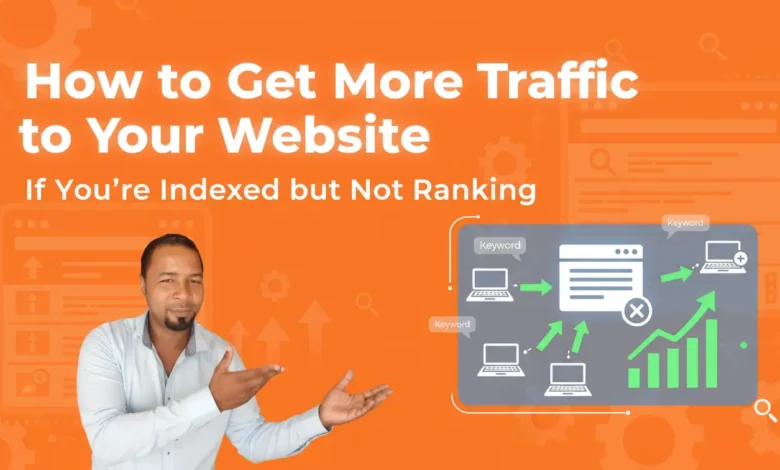
How to get more traffic to your website when your pages are indexed but fail to rank is one of the most frustrating problems website owners and technical bloggers face today. Being indexed means Google can see your site, but not ranking means it doesn’t consider your pages relevant or strong enough to deserve visibility.
How to Get More Traffic to Your Website When Pages Are Indexed but Invisible
If your website is indexed in Google Search Console but receives little or no organic traffic, this is not a content quantity problem and not necessarily a marketing issue. It is a technical visibility and relevance problem.
Indexed but not ranking usually means one or more of the following:


- Google understands your page exists
- Google does not trust it enough
- Google does not see a clear search intent match
- Google finds stronger alternatives elsewhere
This article breaks down the real technical reasons behind this issue and explains how to fix them systematically.
Read Also : Fast Indexing in Google: Why Quick Article Indexing Is the Key to Winning Trend Traffic
Understanding the Difference Between Indexing and Ranking
Indexing simply means Google has discovered and stored your page in its index. Ranking, however, is a competitive process.
Your page is competing against:
- Older domains
- Stronger topical authorities
- Pages with better engagement signals
- Pages that match user intent more precisely
Being indexed without ranking is a signal that Google sees your content but does not prioritize it.
The Most Common Technical Reasons You’re Indexed but Not Ranking
Weak Search Intent Alignment
One of the most overlooked reasons pages fail to rank is intent mismatch.
If users search with problem-solving intent but your page delivers:
- General explanations
- Marketing-style content
- Broad overviews
Google will not rank it.
Search intent today is not about keywords—it’s about expected outcomes. If your page does not directly resolve the user’s situation, it will remain invisible.
Low Click-Through Rate (CTR) From Search Results
Google tracks how users interact with search results.
If your page appears but users do not click:
- Your title is weak
- Your meta description lacks clarity
- Competitors offer clearer answers
Low CTR silently kills ranking potential, even if your content is technically sound.
Content Cannibalization Within Your Site
Publishing multiple articles around the same topic without a clear hierarchy causes Google confusion.
Common symptoms:
- Several pages ranking briefly, then disappearing
- Fluctuating impressions with no traffic growth
- Google choosing the wrong page to display
This happens when:
- Topics overlap
- Intent is duplicated
- Internal linking is weak or inconsistent
Thin Authority Signals
Ranking is not only about the page itself. Google evaluates:
- Internal links pointing to the page
- Contextual relevance within your site
- The authority of surrounding content
If your page exists in isolation without strong internal support, it will struggle to rank.
Technical Trust Barriers
Even when indexed, ranking can be limited by:
- Slow page speed
- Poor Core Web Vitals
- Mobile usability issues
- Excessive ads or intrusive elements
These factors reduce user satisfaction signals, which directly affect ranking stability.
How to Get More Traffic to Your Website Through Technical Fixes
Rebuild the Page Around a Single Clear Problem
Each page should answer one core question only.
Instead of:
- Covering everything about traffic
Focus on: - Why traffic is missing despite indexing
- What technical signals are failing
- How to correct them step by step
Clarity beats comprehensiveness.
Strengthen Search Snippet Performance
Your title and description must:
- Address a specific situation
- Signal immediate relevance
- Reduce uncertainty
A technical audience clicks when they recognize their exact problem in the snippet.
Create Strong Internal Context
Every important page should be:
- Linked from relevant articles
- Positioned within a clear topical cluster
- Supported by related problem-solving content
Google ranks systems, not isolated pages.
Reduce Competition Within Your Own Site
Audit your content and:
- Merge overlapping articles
- Redirect weaker pages
- Assign one page as the main solution
This consolidates authority and removes internal ranking conflicts.
Optimize for User Behavior, Not Just Crawlers
Ranking stability depends heavily on:
- Time spent on page
- Scroll depth
- Interaction signals
Structure content so that:
- The solution appears early
- Steps are clear
- The reader does not need to return to search
Why Technical Solutions Outperform SEO Tips
Generic SEO advice assumes:
- All sites start from zero
- More content equals more traffic
- More keywords equal more ranking
In reality:
- Most sites fail due to technical misalignment
- Not due to lack of effort
- Not due to lack of publishing
Technical solutions diagnose before prescribing.
Sustainable Traffic Comes From Solving Real Technical Problems
Traffic that lasts comes from pages that:
- Match intent precisely
- Solve recurring problems
- Become reference points
This is why some pages continue to receive traffic years after publication—they remain useful, not just optimized.
Conclusion
How to get more traffic to your website when you’re indexed but not ranking is not about shortcuts or volume. It is about understanding why Google sees your page but does not promote it.
Fixing this requires:
- Intent clarity
- Technical trust
- Structural authority
- Behavioral optimization
When these elements align, traffic becomes a natural outcome—not a chase.
Frequently Asked Questions (FAQ)
Why is my website indexed but not getting traffic?
Because indexing only confirms visibility to Google, not relevance or authority. Ranking requires strong intent matching and trust signals.
How long does it take to rank after fixing technical issues?
Results vary, but meaningful improvements often appear within weeks once Google re-evaluates user engagement and page relevance.
Can too much content hurt rankings?
Yes. Excessive overlapping content causes cannibalization and weakens authority instead of strengthening it.
Is SEO still important if technical issues exist?
SEO fundamentals matter, but technical alignment determines whether those fundamentals translate into rankings.
Should I delete pages that don’t rank?
Not always. Merge, redirect, or repurpose them strategically to support stronger pages.