


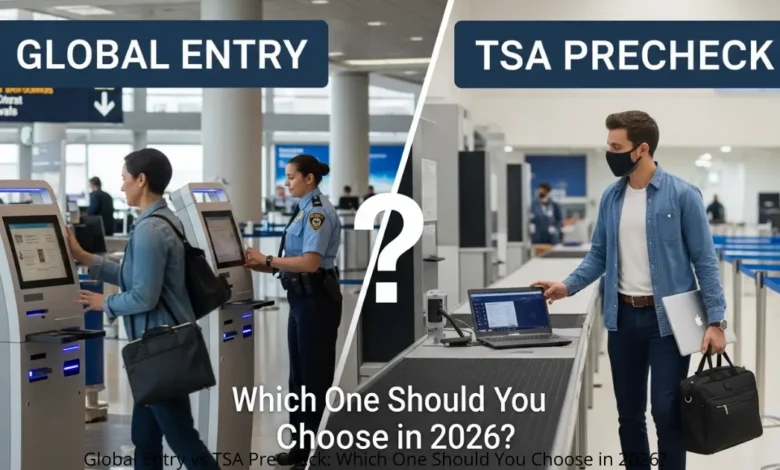
Global Entry vs TSA PreCheck is one of the most searched travel questions in America right now—and for good reason. Airport lines aren’t getting shorter, international travel is bouncing back hard, and nobody wants to waste an hour taking off shoes and unpacking laptops.
If you’re flying in 2026, understanding the difference between these two trusted traveler programs can literally save you hours every year. The right choice depends on how you travel, how often you leave the country, and how much you value convenience versus cost.
Let’s break this down clearly, practically, and without fluff.




Global Entry vs TSA PreCheck: What’s the Real Difference?
When people search Global Entry vs TSA PreCheck, they’re usually trying to decide which program gives them the best value.
Here’s the core distinction:
TSA PreCheck helps you when departing from U.S. airports.
Global Entry helps you when returning to the U.S. from international trips.
That’s it at a structural level. But the real difference is in how the experience feels.
With TSA PreCheck, you use a dedicated security lane. You keep your shoes on. You don’t remove your belt. Your laptop and liquids stay in your bag. The line moves noticeably faster, especially at busy airports like Atlanta, Dallas, or LAX.
With Global Entry, you skip long immigration lines when returning from abroad. Instead of standing in a crowded customs hall after an eight-hour flight, you use automated kiosks or biometric facial recognition lanes and walk through in minutes.
Here’s the strategic part many travelers miss:
If you get Global Entry, you automatically receive TSA PreCheck benefits.
That means Global Entry is essentially a bundle.
Read Also:
I Can Only Imagine 2: Is the Sequel Really Happening and What Comes Next?
Iron Lung Post Credit Scene: Why You Should Stay Until the Very End (Confirmed)
TSA PreCheck Application 2026: Is It Still Worth It?
Search interest around TSA PreCheck application 2026 continues rising because domestic travel inside the U.S. remains heavy.
TSA PreCheck costs about $78 for five years (depending on enrollment provider). The application process includes:
- Online pre-application
- In-person appointment
- Fingerprinting
- Background check
Approval can take a few days to a few weeks.
For travelers who mainly fly domestically—even 3–4 times per year—the time savings are substantial. Security wait times during peak travel seasons can easily exceed 45 minutes in standard lanes. PreCheck often cuts that down dramatically.
If you rarely leave the U.S., TSA PreCheck is cost-efficient and easier to interview for compared to Global Entry.
Global Entry Application Process: What to Expect
Interest in the Global Entry application process has surged, especially after the price increase in October 2024.
Global Entry now costs $120 for five years. The process includes:
- Online application through the Trusted Traveler Program website
- Conditional approval
- In-person interview at a Global Entry enrollment center
- Fingerprinting and background check
The interview process can sometimes be the bottleneck. Appointment availability varies by city. Major metro areas may have longer wait times, though “Enrollment on Arrival” has improved access for some international travelers.
Once approved, you receive a Known Traveler Number (KTN), which activates TSA PreCheck benefits automatically when booking flights.
If you travel internationally even once a year, Global Entry often pays for itself in saved time alone.
Global Entry vs TSA PreCheck Cost Comparison
One of the most searched intent phrases is Global Entry vs TSA PreCheck cost comparison.
Let’s look at this logically.
TSA PreCheck: ~$78 for 5 years
Global Entry: $120 for 5 years
That’s a $42 difference across five years. Broken down annually, that’s roughly $8.40 more per year for Global Entry.
For $8 extra per year, you get:
- Faster re-entry into the U.S.
- TSA PreCheck included
- Biometric expedited processing
From a pure value standpoint, Global Entry wins if you ever travel internationally.
But if you never leave the country, paying extra doesn’t deliver added benefit.
Credit Cards That Cover Global Entry or TSA PreCheck
A major factor in 2026: many premium travel credit cards reimburse application fees.
For example, cards like the American Express Platinum Card and the Chase Sapphire Reserve typically offer statement credits covering either Global Entry or TSA PreCheck every four or five years.
That effectively makes enrollment free if you already carry one of these cards.
Before paying out of pocket, check your credit card benefits portal. Many travelers miss this and end up paying unnecessarily.
Who Should Choose TSA PreCheck?
Choose TSA PreCheck if:
You primarily fly domestic routes inside the United States.
You want a quicker, simpler enrollment process.
You don’t anticipate international trips soon.
You want lower upfront cost.
For business travelers doing short-haul flights between U.S. cities, TSA PreCheck alone often provides sufficient value.
Who Should Choose Global Entry?
Choose Global Entry if:
You travel internationally at least once per year.
You frequently return through busy international airports like JFK, Miami, or LAX.
You want the full bundle of benefits.
You value minimizing total airport friction.
After long-haul international flights, immigration lines can feel brutal. Global Entry eliminates that pain point almost entirely.
Travel Trends in 2026: Why More Americans Are Applying
International travel demand has rebounded significantly. Remote work flexibility and global tourism growth mean more Americans are mixing work and travel.
At the same time, airport congestion hasn’t disappeared.
Security modernization, biometric screening, and automation are expanding, but trusted traveler programs remain the most reliable way to bypass standard queues.
In 2026, convenience isn’t a luxury—it’s a productivity strategy.
If you travel frequently for business, skipping long lines translates into less stress, better scheduling reliability, and fewer missed connections.
Final Recommendation: What’s the Smart Move?
If you’re on the fence, here’s the blunt answer:
If you travel internationally even occasionally, get Global Entry.
If you only travel within the U.S., TSA PreCheck is enough.
The price difference is minimal over five years. The time savings can be dramatic.
And if your credit card reimburses the fee, there’s almost no downside to choosing Global Entry.
Frequently Asked Questions
Is Global Entry better than TSA PreCheck?
If you travel internationally, yes. It includes TSA PreCheck and adds expedited customs re-entry benefits.
How long does approval take in 2026?
TSA PreCheck can take days to weeks. Global Entry may take longer depending on interview availability.
Do I automatically get TSA PreCheck with Global Entry?
Yes. Once approved for Global Entry, TSA PreCheck benefits are included.
Can families apply together?
Each traveler must apply individually, including children.
Is it worth it if I only fly twice a year?
If those trips are international, Global Entry is worth it. If domestic only, TSA PreCheck may be sufficient.