Future of Internet Technology 2026: From Wi-Fi 7 Dominance to the Dawn of 6G
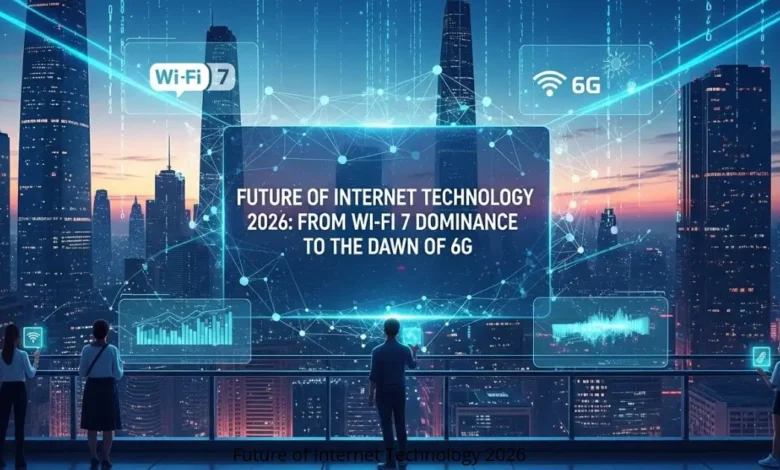
Discover the Future of Internet Technology 2026, from Wi-Fi 7 global dominance to early 6G trials, satellite internet expansion, and quantum-resistant security.
Understanding the Future of Internet Technology 2026
As we move deeper into January 2026, the Future of Internet Technology 2026 is no longer theoretical or experimental. It is unfolding in real time through faster wireless standards, intelligent network management, and global connectivity initiatives that are reshaping how individuals, businesses, and governments interact with the digital world.
At Feenanoor Internet, the focus this year is not just on speed, but on reliability, intelligence, and inclusivity. Internet infrastructure in 2026 is being rebuilt around ultra-low latency, AI-driven optimization, and next-generation security frameworks designed for a post-quantum era.
Read Also: How to Improve WiFi Signal at Home: Practical Strategies for Faster and More Reliable Connection
Wi-Fi 7 as the Backbone of the Future of Internet Technology 2026
One of the clearest indicators of the Future of Internet Technology 2026 is the full-scale global rollout of Wi-Fi 7. With theoretical speeds reaching up to 46 Gbps and real-world performance far surpassing Wi-Fi 6E, Wi-Fi 7 has become the default standard for modern connectivity.
In 2026, Wi-Fi 7 is no longer limited to flagship routers. It is now embedded across:
- Smartphones and laptops
- Smart home ecosystems
- AR/VR headsets and spatial computing devices
- Cloud gaming and remote work environments
Multi-Link Operation (MLO) and improved channel efficiency allow devices to transmit data simultaneously across multiple frequency bands, dramatically reducing latency and eliminating congestion. This shift alone defines a major chapter in the Future of Internet Technology 2026, particularly for immersive digital experiences.
6G Field Testing Signals the Next Internet Era
While 5G remains the commercial standard, the Future of Internet Technology 2026 officially marks the beginning of large-scale 6G field testing. Early prototypes demonstrated this year show data speeds up to 100 times faster than current 5G networks, with latency approaching near-zero thresholds.
Unlike previous generations, 6G is being designed from the ground up to support:
- Real-time AI inference at the network edge
- Holographic and volumetric communication
- Brain-computer interface research
- Autonomous systems operating without human latency tolerance
Although consumer deployment is still years away, the architectural foundations laid in 2026 are critical to the long-term evolution of global internet infrastructure.
Satellite Connectivity Redefines Global Internet Access
Another defining pillar of the Future of Internet Technology 2026 is the maturity of low-Earth orbit satellite internet. Providers such as Starlink and Project Kuiper have reached a turning point, offering stable broadband with latency under 20ms in regions previously considered unreachable.
In 2026, satellite internet is no longer a backup solution. It is becoming:
- A primary connection for rural communities
- A strategic asset for disaster recovery
- A connectivity layer for maritime and aviation sectors
- A catalyst for economic inclusion in developing regions
This expansion plays a decisive role in closing the digital divide and integrating millions of new users into the global digital economy.
AI-Optimized Networks Become the New Standard
Artificial intelligence is now deeply embedded in the Future of Internet Technology 2026. Networks are no longer static pipelines; they are adaptive systems that learn, predict, and optimize traffic in real time.
AI-driven networking enables:
- Dynamic bandwidth allocation based on usage patterns
- Predictive maintenance that prevents outages before they occur
- Intelligent routing to reduce congestion and packet loss
- Automated cybersecurity threat detection
This shift dramatically improves network efficiency while reducing operational costs for service providers.
Quantum-Resistant Security in the Future of Internet Technology 2026
As computing power advances, security has become a central concern in the Future of Internet Technology 2026. Traditional encryption methods are increasingly vulnerable to future quantum attacks, prompting widespread adoption of quantum-resistant cryptographic standards.
In 2026, major platforms and financial networks are already transitioning to:
- Post-quantum encryption algorithms
- Hardware-level security integration
- Zero-trust network architectures
These measures ensure long-term data protection and reinforce trust in digital services, particularly in finance, healthcare, and government infrastructure.
Summary: What Defines the Future of Internet Technology 2026
The Future of Internet Technology 2026 is defined by convergence rather than isolated innovation. Wi-Fi 7 delivers unprecedented local speeds, early 6G research sets the stage for the next decade, satellite internet expands global access, AI transforms network intelligence, and quantum-resistant security prepares the internet for future threats.
Together, these advancements are not just making the internet faster—they are making it smarter, safer, and more universally accessible.
Frequently Asked Questions (FAQ)
What is the most important internet upgrade in 2026?
Wi-Fi 7 is currently the most impactful upgrade, offering massive speed improvements and ultra-low latency for everyday users.
Is 6G available to consumers in 2026?
No. In 2026, 6G is still in the field-testing phase, with commercial deployment expected later in the decade.
How does satellite internet fit into the future of connectivity?
Satellite internet plays a crucial role in extending high-speed access to remote and underserved regions, reducing global connectivity gaps.
Why is quantum-resistant encryption important now?
Because future quantum computers could break current encryption methods, early adoption ensures long-term data security.
How does AI improve internet performance in 2026?
AI enables real-time traffic optimization, predictive maintenance, and advanced cybersecurity, making networks more efficient and reliable.
Discover more from Feenanoor
Subscribe to get the latest posts sent to your email.