

Humanoid Robots: China Moves to Mass Production While the World Watches 2026 Closely

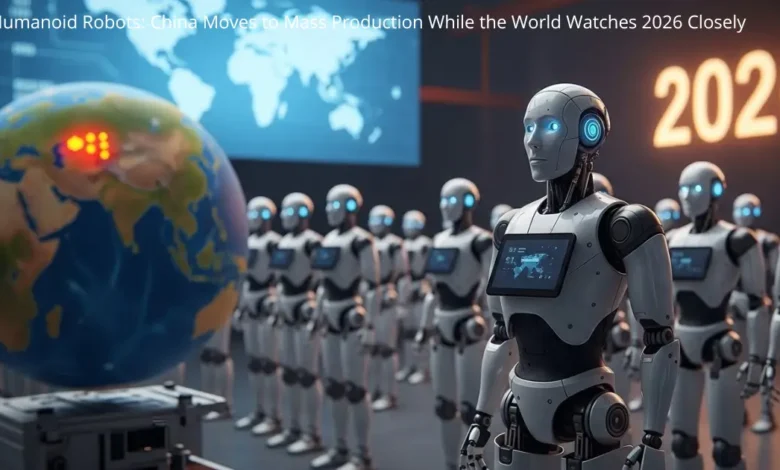
Humanoid Robots mass production marks a major shift in the global robotics race, with China officially moving from advanced prototypes to large-scale industrial manufacturing, while Western tech leaders closely monitor the implications for 2026 and beyond.
Humanoid Robots Enter the Industrial Phase in China
China has officially crossed a critical threshold in the global robotics race by initiating large-scale production of humanoid robots. This move represents a transition from laboratory experimentation and limited pilot projects to structured manufacturing supported by factories, supply chains, and long-term commercialization strategies. Unlike earlier demonstrations designed to showcase technical prowess, the current phase focuses on repeatable production, cost optimization, and deployment readiness.
Several Chinese robotics firms are now producing humanoid robots in batches measured in dozens and hundreds, with clear roadmaps to scale further over the next two years. These robots are no longer conceptual machines built for exhibitions; they are designed for practical use in factories, logistics hubs, research facilities, and controlled service environments.




Read Also: EUV Lithography Machine: The Chinese “Monster” Emerging from a Secret Lab
Why Humanoid Robots Matter More Than Traditional Automation
Humanoid robots differ fundamentally from industrial robotic arms or automated guided vehicles. Their human-like form allows them to operate in environments originally designed for people, reducing the need for costly infrastructure redesign. Stairs, narrow corridors, tools, and workstations built for humans can be used with minimal modification.
This adaptability is precisely why humanoid robots are viewed as the next evolutionary step in automation. China’s decision to push them into mass production suggests a long-term strategy to integrate these machines into the real economy rather than treating them as experimental technologies.
China’s Strategic Advantages in Humanoid Robots
China’s rapid progress in humanoid robots is not accidental. It is the result of a convergence of structural advantages that few countries can match simultaneously.
First, China possesses the world’s most mature electronics and hardware manufacturing ecosystem. Components such as sensors, actuators, batteries, cameras, and embedded processors can be sourced domestically at scale, reducing both cost and production delays.
Second, humanoid robots have been formally classified as a strategic industry within national development plans. This classification unlocks funding, tax incentives, research partnerships, and preferential treatment across multiple industrial zones.
Third, demographic pressures are accelerating automation. An aging population and a shrinking industrial workforce have created an urgent demand for robotic labor capable of handling repetitive and physically demanding tasks.
Finally, cost discipline remains a decisive factor. Chinese manufacturers are aggressively optimizing designs to lower production costs, positioning their humanoid robots to be commercially viable sooner than many Western alternatives.
Global Attention and Elon Musk’s Watchful Eye
The shift toward mass production has not gone unnoticed internationally. Elon Musk, whose company Tesla is developing the Optimus humanoid robot, has repeatedly emphasized that humanoid robots could become more economically significant than electric vehicles in the long run.
Tesla’s approach prioritizes advanced artificial intelligence, vision-based control, and general-purpose reasoning. However, Tesla’s humanoid robot remains in an advanced prototype stage, with large-scale manufacturing still ahead.
The contrast is increasingly clear. While Western companies emphasize intelligence, autonomy, and safety frameworks, China is pushing ahead on manufacturing readiness, iteration speed, and deployment volume. This divergence has fueled speculation that China could dominate the early humanoid robot market through scale, even if Western systems retain an edge in software sophistication.
What 2026 Is Expected to Bring
Industry analysts increasingly view 2026 as a pivotal year for humanoid robots. By that time, China is expected to have thousands of units operating in real-world environments, particularly in manufacturing plants, warehouses, and logistics centers.
Widespread household adoption is not expected in the near term. Instead, the initial wave will focus on controlled environments where tasks are repetitive and predictable. These include material handling, equipment inspection, basic assembly assistance, and internal logistics.
The significance of this phase lies not in consumer hype but in economic impact. Once humanoid robots prove reliable at scale, they could permanently alter labor models across multiple industries.
Technical Limits Still Remain
Despite the momentum, humanoid robots are far from a finished technology. True autonomy, advanced reasoning, and safe interaction in unpredictable environments remain unresolved challenges.
Current systems excel at movement, balance, and task repetition, but they still rely heavily on predefined workflows and human supervision. Achieving human-level adaptability will require further breakthroughs in artificial intelligence, energy efficiency, and real-time decision-making.
China’s strategy appears pragmatic. Rather than waiting for perfect intelligence, manufacturers are deploying robots that are “good enough” to deliver immediate economic value, with software improvements planned over time.
A Shift That Redefines the Robotics Landscape
China’s move into mass production signals more than technological ambition. It reflects a broader shift in how innovation is measured. In this phase, success is defined not by the most advanced prototype but by the ability to manufacture, deploy, and refine technology at scale.
As humanoid robots transition from novelty to infrastructure, the global competition will intensify. Countries and companies that master production early may shape standards, pricing, and adoption patterns for the next decade.
The start of mass production for humanoid robots in China marks a decisive moment in the evolution of robotics. While intelligence and autonomy remain critical long-term goals, the ability to manufacture and deploy robots today may prove equally transformative. As 2026 approaches, the world is witnessing the early stages of a technological shift that could redefine labor, productivity, and industrial power.