
Blood Moon Total Lunar Eclipse: Date, Time, Visibility And Why The Moon Turns Red

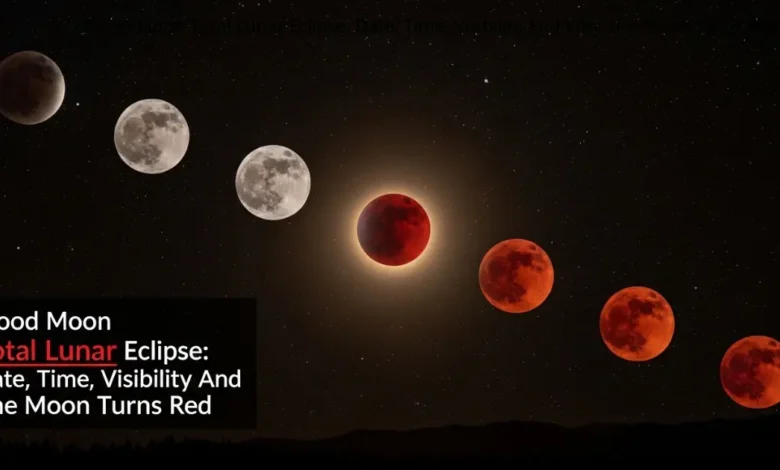
Feenanoor – 26/02/2026 – Will the Moon really turn red on March 3, 2026?
Why is everyone talking about the Blood Moon in 2026?
Everything you need to know about the Blood Moon total lunar eclipse in March 2026, including exact date, time, visibility by region, and the science behind the red Moon.
What Is a Blood Moon Total Lunar Eclipse?
A Blood Moon total lunar eclipse is one of the most striking celestial events visible from Earth, occurring when the planet moves directly between the Sun and the Moon. During this alignment, Earth’s shadow completely covers the Moon, blocking direct sunlight. Instead of disappearing from view, the Moon takes on a deep red or copper hue, a phenomenon that has fascinated astronomers and casual skywatchers for centuries. This dramatic color shift is not a sign of danger or rarity in itself, but rather a predictable outcome of how Earth’s atmosphere bends and filters sunlight during a total lunar eclipse.




Unlike solar eclipses, which require special eye protection and are visible only from narrow paths, a total lunar eclipse can be safely observed with the naked eye and is often visible across large portions of the globe. This accessibility is one of the reasons why Blood Moon events generate significant global interest whenever they occur.
Read Also:
NPR Investigation: Justice Department Withheld Pages From Public Epstein Files, Including References to Donald Trump
Iron Lung Post Credit Scene: Why You Should Stay Until the Very End (Confirmed)
When Is The Blood Moon Total Lunar Eclipse In 2026?
The upcoming Blood Moon total lunar eclipse will take place on March 3, 2026. On this date, the Moon will pass fully into Earth’s umbral shadow, creating a period known as totality when the red coloration becomes most intense. The exact timing of the eclipse will vary depending on geographic location, but the event will unfold over several hours, beginning with the partial eclipse phase, reaching totality, and then gradually returning to normal as the Moon exits the shadow.
For many regions, the most visually dramatic moment will occur during the peak of totality, when the Moon appears darkest and most vividly red. Because the event happens at night for a wide range of time zones, millions of people around the world will have the opportunity to witness it without the need for advanced equipment.
Where Will The Blood Moon Be Visible?
Visibility of the Blood Moon total lunar eclipse will depend largely on whether the Moon is above the horizon during the event. Large parts of North America are expected to have excellent viewing conditions, particularly during the early morning or late-night hours. Portions of Europe, Asia, and the Middle East may also be able to see at least part of the eclipse, depending on local timing and weather conditions.
In regions where the Moon sets or rises during the eclipse, observers may still catch a partial view, which can be just as impressive as totality itself. Unlike solar eclipses, lunar eclipses are not restricted to a narrow viewing corridor, making them far more inclusive events on a global scale.
Why Does The Moon Turn Red During A Total Lunar Eclipse?
The red color seen during a Blood Moon is the result of a process known as Rayleigh scattering, the same phenomenon responsible for red sunsets and sunrises on Earth. As sunlight passes through Earth’s atmosphere, shorter blue wavelengths are scattered away, while longer red wavelengths are bent inward and directed toward the Moon.
During a total lunar eclipse, this filtered red light is the only illumination reaching the Moon’s surface. The exact shade of red can vary from eclipse to eclipse, depending on atmospheric conditions such as dust, pollution, or volcanic particles present in Earth’s atmosphere at the time. This is why some Blood Moons appear bright orange, while others take on a darker, almost brownish-red tone.
How Rare Is A Blood Moon?
Despite their dramatic appearance, Blood Moon total lunar eclipses are not exceptionally rare. On average, they occur about once every one to two years, though their visibility from any specific location is less frequent. Some regions may go several years without seeing a total lunar eclipse, while others might experience multiple events within a relatively short span of time.
What makes the March 2026 eclipse particularly notable is its wide visibility and favorable timing for major population centers. This combination often leads to heightened media coverage and public interest, even though the underlying astronomical mechanics are well understood.
How To Watch The Blood Moon Safely
One of the most appealing aspects of a Blood Moon total lunar eclipse is that it can be viewed safely without any special protective equipment. Unlike solar eclipses, there is no risk to the eyes when observing a lunar eclipse directly. Viewers can simply step outside, find a clear view of the sky, and watch the event unfold naturally.
For those seeking a more detailed experience, binoculars or a small telescope can enhance visibility, revealing subtle color gradients and surface details on the Moon. Clear skies and minimal light pollution will significantly improve viewing conditions, making rural or elevated locations ideal for observation.
Blood Moon Total Lunar Eclipse And Public Interest
Events like the Blood Moon total lunar eclipse consistently generate global attention because they combine scientific significance with visual spectacle. They also serve as accessible entry points for public engagement with astronomy, often inspiring renewed interest in space science and observational astronomy.
With social media and real-time news coverage amplifying awareness, the March 2026 eclipse is expected to be one of the most widely discussed lunar events of the year. For many observers, it will be a reminder of the predictable yet awe-inspiring rhythms that govern the night sky.
Frequently Asked Questions
Is it safe to look at a Blood Moon total lunar eclipse?
Yes, a total lunar eclipse is completely safe to observe with the naked eye and does not require any protective eyewear.
Can the Blood Moon be seen from the Middle East?
Visibility depends on local timing and weather, but many parts of the Middle East may be able to see at least part of the eclipse if the Moon is above the horizon.
Why is it called a Blood Moon?
The name comes from the reddish color the Moon takes on during totality, caused by sunlight filtered through Earth’s atmosphere.
How long does a total lunar eclipse last?
The entire event can last several hours, while the totality phase typically lasts between 30 minutes and over an hour.
Share this:

Discover more from Feenanoor
Subscribe to get the latest posts sent to your email.