

Armed Robots in American Cities: Are Armed Robots Legal in the US in 2026?

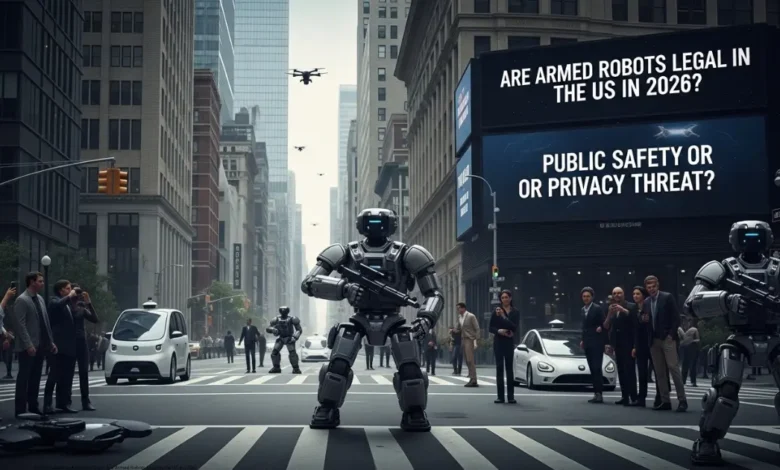
Armed robots in American cities are no longer a futuristic theory — they are part of an active legal, technological, and political debate unfolding right now across the United States. If you’re searching whether armed robots are legal in the US, whether police can deploy weaponized machines, or whether private neighborhoods can use autonomous security systems, this article gives you a direct, fact-based answer.
The short version: armed robots exist, but fully autonomous lethal force is not legally permitted without human oversight. The longer answer is where things get complex.
Are Armed Robots Legal in the US?
The legality of armed robots depends on how “armed” and “autonomous” are defined.




As of 2026:
- Remote-controlled police robots are legal under strict supervision.
- Fully autonomous lethal robots are not legally authorized for civilian deployment.
- State-level AI laws are shaping how these systems can operate.
Two states dominate the regulatory conversation: Texas and California. Their approaches could define the national model.
Texas AI Law TRAIGA: Innovation with Compliance
The Texas AI law TRAIGA (Texas Responsible AI Governance Act) went into effect in January 2026. It does not ban autonomous systems outright. Instead, it requires:
- Transparency in AI design
- Full documentation of algorithmic decision-making
- Clear accountability chains
Under TRAIGA, security robotics companies must demonstrate responsible deployment standards. That includes audit trails, bias testing, and human override capabilities.
Texas allows development and limited deployment of autonomous security systems, but it does not authorize independent lethal decision-making. Any use of force must involve human command authority.
This regulatory model is business-friendly but liability-aware.
Read Also:
D.O.G.E 2026: How Musk’s Efficiency Dept is Rewiring US Tech & AI Policy
Oppo Reno 15 Pro Max Review: Is It the Ultimate Samsung & iPhone Killer in 2026?
California AI Liability Law AB 316: Strict Responsibility
California takes a more restrictive position through legislation such as AB 316, commonly referred to as a California AI liability law framework.
California prohibits companies from using “AI autonomy” as a legal defense. If an AI system causes harm, humans and organizations remain responsible.
Cities like San Francisco have debated — and in some cases restricted — robotic force authorization to emergency-only scenarios requiring command-level approval.
California’s philosophy is clear:
No autonomous lethal force.
No shifting blame to algorithms.
No deployment without oversight.
This model prioritizes civil liberties over rapid technological rollout.
Can Police Use Weaponized Robots?
Yes — but only in controlled circumstances.
The defining precedent occurred in Dallas in 2016. Police used a bomb-disposal robot carrying explosives to stop an active sniper. The robot was remotely operated; the decision was made by human officers.
That event did not legalize autonomous weapons. It demonstrated that robotic tools can be used under extreme emergency conditions.
In 2026, police departments may deploy robots for:
- Bomb disposal
- Hostage scenarios
- Hazard containment
- Tactical surveillance
However, any lethal force requires human authorization. There is no U.S. jurisdiction currently permitting a robot to independently decide to kill.
Private Security Patrol Robots Legality
Another high-volume search question:
Can private neighborhoods use armed security robots?
Private residential communities increasingly deploy patrol robots equipped with:
- 360-degree surveillance cameras
- Thermal imaging sensors
- License plate readers
- Loudspeaker warning systems
Most are not armed with lethal weapons. Some proposals include non-lethal deterrents such as taser-style mechanisms or acoustic dispersal tools, but these remain legally sensitive.
The unresolved issue is liability:
If a privately operated robot uses force and injures someone, who is responsible?
Potentially:
- The security contractor
- The property management company
- The robot manufacturer
- The software developer
There is no definitive federal ruling yet on privately deployed weaponized robots. Courts are expected to address this within the next few years.
The AI Responsibility Gap
One of the most important legal concerns is the “AI responsibility gap.”
Autonomous systems rely on:
- Computer vision models
- Behavioral prediction algorithms
- Sensor fusion systems
- Real-time risk assessment software
Even with 98% accuracy, a 2% failure rate in dense urban settings could lead to wrongful targeting.
Bias in training data can increase misidentification risk. Environmental factors such as lighting, weather, or occlusion can degrade accuracy.
In e-commerce, algorithmic error is inconvenient.
In public safety, it is legally and morally catastrophic.
That’s why lawmakers insist on a “human-in-the-loop” requirement.
Are Fully Autonomous Lethal Robots Allowed?
No.
As of 2026:
- No U.S. state openly permits fully autonomous lethal robots in civilian areas.
- All known use-of-force robotic systems require human authorization.
- Federal-level AI safety frameworks are under discussion but not finalized.
The United States is currently testing regulatory models at the state level before establishing broader federal standards.
Why This Debate Matters Nationally
This issue is bigger than robotics.
It touches on:
- Civil liberties
- Due process
- Constitutional protections
- Public accountability
- The future of AI governance
If Texas’ regulatory model proves workable, other pro-innovation states may replicate it. If California’s liability-first approach dominates litigation outcomes, stricter national rules could follow.
The decisions made between 2026 and 2028 will likely shape global AI weapon regulation standards.
Final Answer: Should You Be Concerned?
You should be informed.
Armed robots in American cities are not roaming freely without oversight. But autonomous security technology is advancing faster than comprehensive legislation.
The real issue is not whether robots exist.
It’s whether laws evolve quickly enough to define:
- Who controls force
- Who bears responsibility
- And how civil rights remain protected
The debate is ongoing — and it directly impacts the future of public safety in America.