

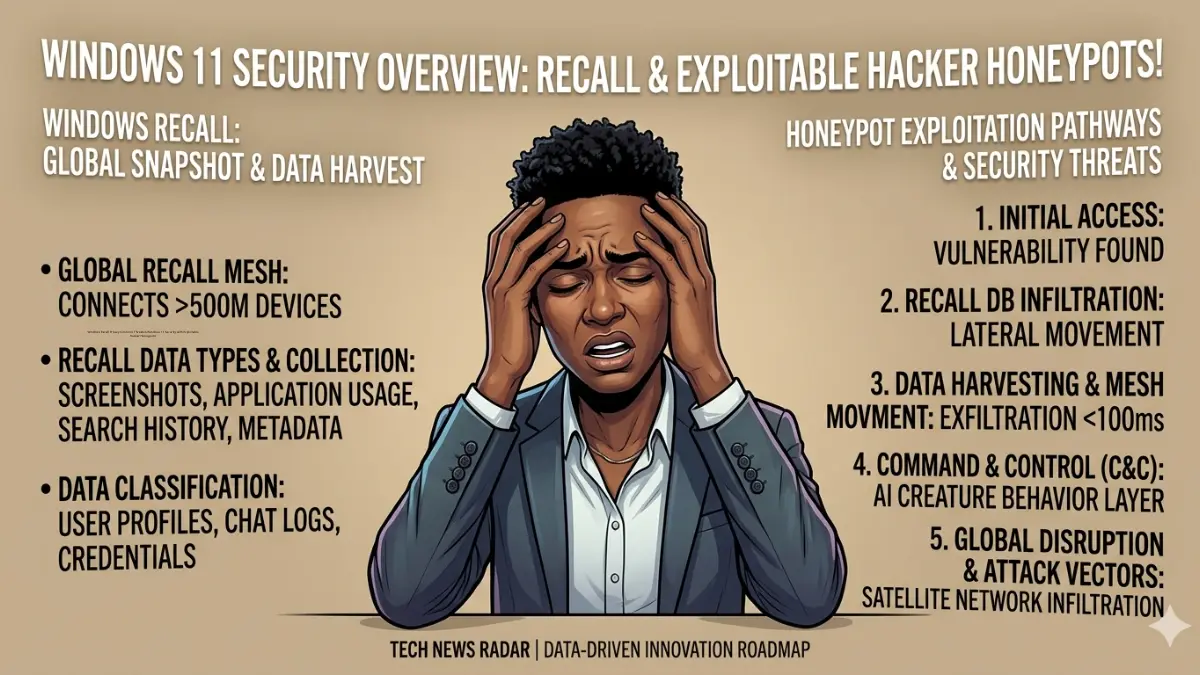
REDMOND, June 18, 2026 — Global cybersecurity fortresses are shifting into an immediate state of defensive alert today as Windows Recall privacy concerns undergo intense forensic auditing by independent reverse engineers. Despite severe industry warnings, Microsoft has officially reintegrated its automated, continuous desktop-imaging engine into core consumer distributions. The system utilizes localized silicon power to take persistent cryptographic snapshots of an individual’s interface every few seconds, constructing a fully searchable historical index of a user’s entire digital lifespan. Rather than viewing this as an intuitive utility, cryptographic researchers argue that the software operates as an integrated operating-system backdoor, completely shifting the dynamic of personal data safety and outclassing the monitoring anxieties raised in our recent Microsoft Teams Workplace Check-In reports.
The Infostealer Blueprint: Unencrypted SQL Databases and Local Malware Exploitation
The core structural vulnerability driving intense technical anxiety is the precise file architecture chosen to house this continuous visual stream. Software analysis reveals that the system aggregates these captured images and translates them via optical character recognition into a localized SQLite database. Because this centralized repository mirrors every single password, secure banking token, and confidential corporate email that renders on the screen assembly, it presents an irresistible target for modern exploit developers. White-hat testing groups have already demonstrated that standard background malware scripts can easily execute privilege escalation routines to copy the database file entirely, bypassing traditional operating-system partitions and accessing months of private user history in a fraction of a second.
Read Also:
Apple Siri AI Settlement Claim: How to Get Your Compensation Step-by-Step
Redefining Endpoint Security: Corporate Data Leaks and Regulatory Friction
This alarming hardware-level exposure has forced prominent information security officers to look beyond traditional antivirus protection to address growing Windows Recall privacy concerns across corporate network environments. Enterprise system administrators are warning that leaving this snapshot pipeline active fundamentally nullifies standard data-loss prevention protocols, since a single compromised terminal can now leak an employee’s total operational footprint.
This corporate defense movement has triggered severe friction with data watchdogs in international jurisdictions, who are actively checking whether Microsoft’s background recording grid violates strict regional privacy standards. This intense regulatory friction mirrors the global compliance stalemates blocking Western software ecosystems, such as the ongoing disputes analyzed in our comprehensive Apple Intelligence EU Launch tech updates.
Technical Elimination: Hard-Disabling the Recall Binary via Registry Modifications
Because simple software settings panels have failed to convince the global developer community that their data remains completely unmonitored, advanced users are turning to raw file-system modifications to secure their hardware. Systems engineers are publishing manual Registry Editor scripts and group policy overrides designed to completely strip the background tracking binaries from executing during system boot sequences.
This grassroots developer rebellion proves that power users are increasingly unwilling to trade raw system integrity for automated AI assistance, driving thousands of independent software creators learning the best way to learn javascript to build automated, open-source privacy patches that permanently seal off their local storage arrays from unauthorized corporate indexing loops.
Summary: The Catastrophic Cost of Passive Operating-System Surveillance
By forcing an engineering structure that permanently archives a user’s active pixels, Microsoft has introduced a foundational flaw into the modern personal computer environment. Until the architecture is completely redesigned to prevent local malware extraction, leaving this tracking engine operational introduces an unacceptable hazard to the global digital landscape.
Frequently Asked Questions (FAQ)
- Can remote hackers access the Windows Recall screenshot database?
If a remote attacker deploys an infostealer script that gains administrative access to your local user directory, they can instantly extract the SQLite database file and view your entire history. - Does Windows Recall bypass secure incognito browsing sessions?
Yes, unless specifically configured via system policy adjustments, the baseline automated capturing tool records every active window on your display assembly regardless of an app’s private browsing status. - Is it possible to completely uninstall the Recall feature from Windows 11?
While Microsoft hides the feature within core system folders, enterprise administrators can permanently block and disable the tracking service using custom registry files or system policy adjustments.